Monday, September 23, 2013

Why I still believe in the African rebirth

Text of my talk at TEDxLilongwe, 25th May, 2013

Watch the Youtube video here

When I started blogging in 2005, I gave my blog a Chichewa name. Chichewa is my first language, spoken by more than 80 percent of Malawians. It’s also spoken in parts of Zambia, Mocambique and Zimbabwe. I gave my blog the name “Afrika Aphukira.” In Chichewa that translates as “Africa will have a rebirth.” It’s been eight years since, and every other African country seems to be undergoing a rebirth, with the exception of Malawi, if you ask the average Malawian.

Speakers at TEDxLilongwe, 25th May 2013

Two weeks ago, the Africa Progress Panel released the 2013 Africa Progress Report. The foreword, by Kofi Annan, chairperson of the Panel, starts with the following sentence: “Africa is standing on the edge of enormous opportunity.” Headlines from global media are salivating on new discoveries of mineral and oil deposits in the African soil. Sceptics have retorted with the line: Africa is rising but Africans are not. The same 2013 African Progress Report reveals that Africa is losing $34 billion annually from its mining and oil deals.

Researchers from Oxford University have given Malawi 74 years before the country can eradicate poverty. That gives us up until the year 2087. When I first saw this headline in the Daily Times of 22nd March this year, I thought of the millions of Malawians for whom daily life is a struggle. I thought of the glaring contradictions: glamorous shopping complexes facing the most dilapidated market squares, separated by a heavily potholed Devil Street.

I thought of this particular stretch in a busy part of Old Town Lilongwe: a bank, a superette, an expensive restaurant, a mobile phone company, and two upscale car dealerships. Look at the street running along these structures, and 74 years doesn’t look enough. Then I thought of those who had already had their poverty eradicated.

The African rebirth I am envisioning is not based on global media headlines. It is Africa-owned; it derives its meaning from the term ‘uMunthu.’ This word means personhood in Chichewa. uMunthu is about how our humanness is tied to that of others. We say “You are, therefore I am.” The question I always ask myself is: what would it look like if uMunthu were at the centre of social policy and governance? Let me illustrate this.

In June 2010 I met a group of teachers from several primary schools here in Lilongwe. The purpose for the meeting was to start what we hoped would be a forum where teachers would regularly meet and help one another become better teachers. A bigger goal was teacher empowerment; an attempt to address the helplessness and hopelessness many teachers feel about the conditions of their schools and their profession.

As I returned to my car at the end of the meeting, I was approached by one teacher. His name was Amos Matchakaza. Amos asked for a ride to a local college, where he was studying for his bachelors’ degree. I asked Amos how he was managing to pay for his bachelors’ degree courses from his teacher's salary. He said 90 percent of his salary went to pay for tuition. They had had their electricity disconnected because they couldn’t pay the bill. He was not eligible for any government loan, nor any form of support towards his higher education. He was only able to make it because his wife was also a primary school teacher.

That evening I tweeted about Amos. A friend of mine, and former classmate from primary school, sent me a direct message. His name was Hastings Fukula Nyekanyeka. He wanted to know more about Amos. Hastings promised to support Amos until he finished his bachelors’ degree. That was June 2011. In March this year 2013 Amos graduated with his degree.

On 10th November 2012 the weekly Malawi News published a story about Mike Demesterb Nkhoma. Nkhoma dropped out of Form One, first year of secondary school, because his father could not afford the school fees. He started working as a garden boy for a lecturer at the University of Malawi’s Kamuzu College of Nursing. Her name was Juliana Lunguzi.

Juliana sent Mike to a boarding secondary school. Mike scored distinctions in Mathematics, Agriculture and Biology, and was selected to the prestigious University of Malawi College of Medicine. Juliana kept supporting him, and in November 2012 Mike graduated as a medical doctor. Today Dr. Nkhoma is practicing medicine at Malawi’s biggest referral hospital, Queen Elizabeth Central Hospital.

Even more remarkable is the example Mike set for his sister. She had dropped out in Form Two, second year of secondary school, for the same reasons as her brother. She got married and went on to have four children. Her brother Mike’s story made her rethink her future. She went back to secondary school. She made it to the University of Malawi’s Kamuzu College of Nursing, and is in her final year of her bachelors’ degree programme. Then there is the story of William Kamkwamba, The Boy Who Harnessed the Wind.

The reason why many Malawians do not achieve their ambitions is how we look at human potential. We look at human potential as a fixed quantity. If one fails at school, they must be dull. This thinking leads to policies and practices that limit the potential of many Malawians. It has led to policies which favour heavy social investments in elitist structures, and little to no investment in the lives of poor people. That is why in Malawi today the government pays millions of Malawi kwacha every year to students attending public universities, while tens of thousands of younger Malawians drop out of primary and secondary school every year because they cannot afford the fees or the expenses associated with going to school.

In its Malawi Demographic and Health Survey 2010, the National Statistics Office reported that 70 percent of Malawians aged 18 years and above have never had a secondary school education. Some of the reasons for this are lack of resources and the size of the Malawian economy. But a less discussed factor is the assumption, prevalent in our policy making, that intelligence and human potential are limited.

The stories I have shared today confront these assumptions. These stories offer a beginning for us to define the rebirth of the country, and of the continent, on our terms. These stories are the reasons why I still believe in the coming rebirth of Malawi, and of Africa. They are the reason why I still believe in uMunthu. Thank you.

Wednesday, September 18, 2013

What I saw the night Paul Mphwiyo was shot

I was in the Area 43 MASM clinic with three family members and a family friend when Paul Mphwiyo staggered into the ward we were in. It was around 11.30pm on Friday, September 13th. He was walking by himself, fully clad in his suit. He was holding a heavily bloodied bathing towel to his mouth. At first I thought the towel was brown in colour, but I realised it was the blood. A heavy trail of blood followed him. The nurses were directing him toward a bathroom that passed through the ward. The clinic’s water supply had stopped a few hours earlier.

Paul was talking, but it was inaudible. His wife and teenage daughter were following behind, together with a number of nurses. He went past us, and pushed open the bathroom door. One nurse instructed him to lie on a bed in the bathroom area. He was still trying to talk. I heard him say "I'm choking" a number of times. He was choking on his own blood. He was trying to cough out what I imagined to be one of the bullets. He was breathing painfully and unnaturally. It was extremely frightening.

At this point we didn't know who it was, but we heard the wife making frantic phone calls. We were able to piece together what she was saying on the phone and learned that he had been shot. We  asked the daughter who he was, and she told us his name. I immediately knew who it was, because he had been actively involved in the debate on whether to devalue the kwacha or not when Bingu was still alive. I also remembered the news item that announced he had been appointed as the new Director of Budget.

We asked the family if the police had been notified, and they said no. I dialled the "Ndakuona" number (0800900997). It went unanswered. I tried it several times, and nobody picked up. The wife asked for the number so she could also try it. Still nobody picked up. I then dialled the number of one Officer in Charge of a nearby police station. It too went unanswered. Several times. I then dialled the number of a CID officer I know. He answered. It was now exactly midnight. I explained to him what had happened, and that the Ndakuona number was not being answered for the entire half hour I was calling. He said he would call me back after a few minutes to give me other numbers to try. He called back after three minutes. He gave me numbers for a deputy Officer in Charge, and a CID head of a nearby police station. I tried both numbers; one went unanswered, the other was out of reach.

I sent out a tweet describing what had happened, and asking if there was a police officer on my timeline. I didn't mention the name. I tried Ndakuona yet again, still no response. Then I tried the two numbers one more time. The deputy officer in charge responded, and I gave him the details of the house, which Paul's daughter had given me.

Meanwhile, the nurses had put a call through to the doctor on call. He came within minutes. It was Dr. Hetherwick Ntaba. He took control of the situation, and managed to stabilise Paul's condition. He issued instructions to the nurses, and spoke to Paul in a calm, knowledgeable and authoritative voice. Dr Ntaba told Paul they needed to clear his air passage so he could breathe normally. Before long Paul stopped making the unnatural sounds. Had Dr Ntaba arrived half an hour later, I doubt Paul would still be alive. An ambulance arrived, and they quickly transported Paul to KCH. Another member of my family had asked Paul's daughter what their religion was, and she said they were Catholics. We called a friend in Area 43 and suggested they alert their parish priest. One parishioner drove to the priest's house and drove him to KCH. We left the MASM clinic at 1am.

When it was launched with lots of fanfare in 2012, the Ndakuona number  was a life saver. On three previous occasions when I have called the number, there has always been someone on the other end, taking calls. But the number has also been subjected to abuse. There have been reports of people calling the number not to report an emergency but to hurl insults at the police. Some have called the number and have sent police on false chases. The number fields calls from across the country, which I suspect might cause congestion and delays in sending out alerts to police patrols.

It is probably time to review the emergency response system for the police, hospitals, and other early responders. It was unsettling to know that Mphwiyo walked into a hospital that had no running water at that moment. The frantic scampering of the nurses indicated they were ill-prepared for that kind of emergency, but it was to their credit that they did the best they could before the doctor on call arrived.

One police emergency responder told me that the number is too unwieldy; you need to save it in your phone as it is ten digits long. Emergency numbers need to be short and easy to memorise. We have had 990 and 997 before, I am not sure why they were abandoned and replaced with a ten-digit number. In these days of GPS technology, it is possible to pin down the specific geo-location of a phone call.

People caught abusing the system need to face penalties. It may be time to consider ending the open system of acquiring mobile sim cards without having to register and submit one’s details. I realise this has implications for freedom of speech and rights to privacy, but what is the alternative, when the lives of Malawians are in danger?


In support of Malawian feminism

The debate Malawian women are having about gender and the political space is painful to watch, but it raises one question. Can this debate prove to be a turning point in the way Malawians discuss gender and politics? Regardless of how you answer this question, the challenge for men who don’t take gender as a matter of national importance, and women who don’t believe in the existence of patriarchy, is to respect the women engaged in the debate, and learn from them.

The most important lesson to have emerged out of the current discussion is that the women are holding an open debate about women’s role in leadership without men dictating the terms of the debate.  The debate is a practical application of feminism. It demonstrates that women can be free to disagree with President Joyce Banda, and can avoid falling into the uncritical position that they should vote for a president on the simplistic basis that she is a woman. Rather, the decision as to whether or not to vote for President Banda, as Jessie Kabwila and Seodi White argue, should be based on what she achieves for the empowerment of Malawian and African women.

This is a high order level of thinking, lacking in most debates Malawians have around our male presidents. As bell hooks (famous for preferring small letters and no capital letter in her name) writes in her book Feminist Theory: From Margin to Center (2000), no other social justice movement has been as self-critical as the feminist movement. She adds that internal critique is critical to any political transformation. In my humble opinion, Malawian women are currently engaged in such an internal critique.

High order thinking

Since this debate started some weeks ago, I have heard from several women who disagree with Jessie Kabwila and Seodi White, the two feminists leading the argument about the need to vote based on achievement and not uncritical sisterhood. The point here is that the women who express the disagreement are themselves practising exactly the kind of critical analysis that Kabwila and White are calling for. These women are refusing to uncritically follow Kabwila and White on the simplistic basis that Kabwila and White are fellow women and therefore should not be criticised.

The intriguing thing is that some of the women I have heard criticising Kabwila and White are not doing it with the consciousness that they are in fact enhancing the terms of the debate and thereby helping change the way we conduct national discourse in this country. Some of them are expressing the criticism because they do find it objectionable that women activists are criticising a fellow woman occupying Malawi’s highest office.

Others are criticising Kabwila and Kapasula on the basis of political partisanship, seeing the criticism against President Banda as criticism aimed at their political party. A considerable number of women are worried about the tone set by Kabwila and White, seeing it as unnecessarily harsh and uncomfortably confrontational. Yet others are voicing their criticism for reasons of the very patriarchy that Kabwila and White are famed for waging battle against. It is not uncommon to hear women disavow the feminist label, drawing a distinction between a feminist and a woman activist.

The reason why some women are feeling scandalised and fatigued by the conduct of the debate is itself rooted in the very patriarchy Kabwila and White work hard to end. As the feminist saying goes, “well-behaved women seldom make history.” This saying should not be misunderstood to mean that women should be aiming at making history for the sake of it. Rather, it should signal to us the pressure many women feel to appear “well-behaved” in a society which defines women’s behaviour on men’s terms. This is the point that was picked up on by Kabwila and White from what President Joyce Banda said in her Nkhata Bay speech about the questionable marital status of some Malawian women activists.

The need for more women candidates in 2014

It is a pity that thus far President Joyce Banda is the only woman candidate in a field that is increasingly likely to be male-dominated, as it has always been. This is where the question being debated by the Malawian women activists comes in. It is a classic dilemma that has divided electorates across the world and across history: reducing the premise for choosing a candidate to a banal factor. In 1994, a lot of Malawians were reduced to this premise when they said “Bola wakuba yemweyo”, in reference to then-UDF presidential candidate Bakili Muluzi. In the 2004 presidential elections in the United States many Americans used the expression “Anybody but Bush”. In both elections, it was the candidate presented as the baser choice that won the election.

My personal preference for 2014 is to vote for a woman president. But there needs to be more women standing, otherwise the choice becomes constrained in the manner highlighted by this debate. This is not to say President Banda has no redeeming grace worthy people’s votes. A lot of international commentators are failing to understand why there seem to be two Joyce Bandas: the Joyce Banda causing so much debate and controversy within Malawi, and the Joyce Banda who has won the hearts of the rest of the world.

Presidency Banda’s ascendancy to the highest office happened at a time when Malawians were collectively re-evaluating their expectations of what Malawian leadership ought to achieve for ordinary Malawians. At the heart of that re-evaluation has been the question of whether the leadership this country has had since independence has been the key reason why development has been too sluggish. Add to that the problems in the economy and increasing socio-economic inequality between the tiny wealthy elites and the rest of us, President Banda’s presidency has been subjected to unprecedented levels of scrutiny.

In the early days of her presidency Dr. Joyce Banda sought to demonstrate a remarkable closeness to ordinary people, cutting a motherly figure with a strong African woman ethos. It persuaded some Malawians, and a lot of foreign observers, but not Malawian chauvinists, who were unable to imagine a woman taking charge while espousing the ethos of an African woman. Some observers detect a shift from the feminist ethos to a masculine tone that seeks to rival the streetwise machinations of her predecessors. The more she has resorted to that style, the louder the criticism has become.

Seizing the new moment

But the ascendancy of President Banda to Malawi’s highest office can be argued to be a fruit of the gradual shift in gains from the feminist and the women’s movements. Not because of the manner in which her predecessor vacated office, but because the occasion found her poised to assume the role. Despite his inner contradictions, the late Bingu wa Mutharika knew about the importance of women’s empowerment, even if he pursued it for his own political gain.

It is undeniable that Joyce Banda’s presidency has excited the echelons of women‘s leadership globally. Women leaders around the globe are organising themselves and planning to use her presidency as a turning point for how development is defined and delivered. This is a not conspiracy, but rather a serendipitous moment when Malawians and Africans are re-inventing the notion of development toward a more grassroots-oriented understanding of empowerment.

There are lessons to be learned from this debate. It is time Malawian men learned to respect women’s ways of debating, and to refrain from wanting to dictate the terms of those debates. To those men who are dismissing the debate as typical of women’s bickering, and to those women who are feeling embarrassed by the debate, take note that Malawian feminism is coming of age.


In the words of bell hooks (2000), “And even though trashing feminism has become commonplace, the reality remains: everyone has benefitted from the cultural revolutions put in place by contemporary feminist movement. It has changed how we see work, how we work, and how we love.” 

Note: A shorter version of this article appeared in the Malawi News of Saturday 14th September, 2013

Sunday, June 30, 2013

Getting MUST right: New university, new opportunity

The pleas from government-sponsored students in Malawi’s public universities for a raise in their monthly allowances seem to be just what this country needed to begin a conversation on how to overhaul the way we fund public universities. The opening of MUST later this year, as announced by Hon. Eunice Kazembe in June, gives the country a chance to recreate the blueprint for how to provide university education.

Government-sponsored students in Malawi’s public universities are not only afforded a free university education, they are “lucratively employed” to pursue a university education, as somebody put it on my facebook wall some weeks ago.  As Minister of Education Hon. Eunice Kazembe explained on MBCTV recently, each government-sponsored student receives up to K400,000 per year in allowances. It is one thing to go to university for free, it is a different thing to be paid in the process.

If MUST will be run in the same business as usual terms as the other universities, then it too risks going through the same disruptions that have come to characterise the already-existing universities. Indications are that a major rethink is underway, going by what Hon. Kazembe and Dr. Emmanuel Fabiano, Vice Chancellor of the University of Malawi, have recently pronounced. Three things stand out as in dire need of a rethink as Malawi prepares to open its fourth public university. These are the much-debated quota system, student allowances, and loans.

Malawi University of Science and Technology. Photo courtesy : Nyasatimes

The reason why the quota system is the most controversial idea in Malawian higher education debates is because of the capacity problems in our universities. We are not moving quickly enough to address this problem. In 2011 a survey of 150 countries repeated what many of us already know, that only 0.3 percent of young Malawians in the 17-22 year age range are actually in university, placing Malawi last on the list. It is not difficult to understand where the low percentage is coming from.

The most recent intake into the University of Malawi, for the 2012/2013 academic year, was 908. The university administered the university entrance exam to 8507 candidates, out of which 6373 candidates passed. The Lilongwe University of Agriculture and Natural Resources (LUANAR) based its 2012/2013 selection on the same University of Malawi entrance exam, and admitted 456 students. The intake for Mzuzu University was 637 students, which includes upgrading students. The total comes to 2,001 students entering into the three existing public universities for the 2012/2013 academic year. The intake for private universities combined is much lower.

TEVETA’s last intake into technical colleges was 1,580, and teacher training colleges take in about 4,000 students annually. Even when we combine nurses’ colleges and other private colleges, the number of college-age Malawians actually in tertiary institutions is still less than 10,000.
The number of students who sat the 2012 Malawi School Certificate Examination was 111, 781. Out of these, 57, 906 passed. This year the universities will invite about 8,500 of these to sit the next entrance exam, but we should not let that number distort the real figure of Malawians who qualify for university education every year. Everyone who passes the MSCE exam demonstrates an intellectual capacity for higher education. That number stood at 57,906 last year.

If MUST is going to avoid the quota quagmire, admission will have to be based on what Limbani Nsapato calls a “win-win university quota selection system.” By this Nsapato means a system that is based on both merit and socio-economic factors that include gender, disability and poverty. This would give students from rural districts of Malawi and from marginalized backgrounds an equal chance of being selected. Currently, these groups stand little chance.

The second thing MUST must get right is the student allowances. The solution is to start by admitting as many students as the university has space for. Students will be asked to pay the full tuition fees. Hon. Kazembe told the nation last week that more than 60% of entering students in our public universities come from wealthy families and can afford the full tuition fees. Those able to pay will pay. Those unable to will apply for the available scholarships, providing incontrovertible evidence of their inability to afford the fees. Scholarships can include the much-debated allowances, commensurate with cost of living, for the students who demonstrate the need. But everyone else will be admitted on the full knowledge and expectation that they will bear the cost. Currently, the practice is to admit only those for whom the government has reserved a scholarship, many of whom are capable of paying the full fees.

The third thing will be the provision of loans, which will allow those in between to also pursue their education. But a crucial part of getting the loan system right will be loan repayment by alumni. It remains a mystery why we as a nation have failed to put in place a loan system that would have by now helped our universities expand and admit many more students than is the case now (as I argue in an earlier article, loans must be approached with great care. In the US, where student loans are widely available, they have become a burden on graduates, and threaten the country's economic stability).

MUST offers us a new opportunity for a fresh start.

Note: This article appeared on the 'My Turn' oped page of The Nation, Friday 21st June, 2013, under the title 'Getting Must Right From the Onset'.

Distinguishing between cultural revival and ethnic chauvinism in Malawian politics

I have lost count of how many times I have heard the term “harmful cultural practices.” One would think that every aspect of what is supposedly Malawian “culture” is harmful, and must be stopped. The problem is not whether some practices are harmful or not, rather it is what constitutes our understanding of what we call “cultural”. A lot of what is called “cultural” in this particular context has nothing to do with culture. It has everything to do with gender-based violence and abuse fomented by economic, political, social and gender dynamics that masquerade as “culture” when they are not.

Notwithstanding the onslaught that is threatening to obliterate everything to do with “culture”, the country has seen an unprecedented proliferation of cultural preservation groups. While some of these groups have organised quietly and with noble goals, others have taken advantage of the political fortunes of their clansmen and women, and sought political mileage out of ethnicity. In critiquing how we define culture, we are not dismissing the existence of genuine culture and institutions that define a society. Rather, we are guarding against the abuses and excesses of the concept of culture and the tendency for political hijacking of government structures.

Performing artist Masankho Banda performing a story at TEDxLilongwe, 25th May 2013 

It is difficult, but extremely important, to distinguish between cultural preservation and ethnic chauvinism. The difficulty becomes more prominent when we factor in the recalcitrance of our political class to observe separation of powers. Whenever you hear the cry “Bomaaaa” it is usually from party diehards who see their ruling political party and the government as one and the same. It is a hangover from the one-party era that we have failed to cure.

Cultural preservation is an important part of national development, and it must be supported by government infrastructure through constitutional provisions and educational programmes. Separated from political party machinations, government support for cultural preservation provides a level playing field for all ethnicities. We are coming from a history of ethnic chauvinism in which some ethnicities were privileged over others. That set the tempo for how successive governments and their ruling parties have treated the issue of ethnic nationalism.

The reasons why Malawian ethnic groups are clamouring to be recognised may sound counter-tuitive, at first glance. We are yet to deal with the legacy of colonialism which entrenched in us an inferiority complex about our culture, our identity, and our very being. Religions that were imported into the country succeeded on the back of the success of that campaign to inferiorise our very core identity. We have never recovered from that spiritual vanquishing.

It is this recognition that ought to guide the government’s role in restoring cultural pride. If colonialism defeated us on the basis of our identity, any rebirth we wish to initiate will have to be based on reclaiming our worth as human beings. This will be very hard, particularly for those of us convinced that nothing in our existential identity is worth salvaging.

We pay a heavy price for the inferiority complex imposed on us. Our political class has abandoned all sense of agency in taking control of our destiny. We see all social problems as beyond our capacity to deal with them. We scorn and abandon everything that reminds us of our ancient past, which we have been schooled had nothing to do with greatness. Even the efforts we are making at cultural revival are merely cosmetic. What they are achieving to revive are the outward manifestations of culture, in the form of dances, rituals and regalia. These do have their place in cultural preservation, but they do not form the complete cultural agenda.

For this cultural revival to be meaningful, we need to deepen our understanding of the bigger purposes of why we exist as a people. We need to go beyond the outward appearance of culture and identify beliefs and attitudes that affirm our existence and develop our sense of community. This calls for a critical examination of the structures we have inherited for governance and development. We have inherited systems that privilege very few people while marginalising the majority of Malawians. The development agenda in our country is in the hands of only those who can understand the English language, yet the majority of Malawians do not use that language.

This is why even after nearly five decades of independence, the majority of Malawians have not been afforded the opportunity of a meaningful education. A meaningful education does not confer upon one knowledge for the sake of knowledge only. Education entails a deeper understanding of one’s purpose for existing and for belonging in a community. Our guiding purpose ought to be making Malawi a better place than we found it, starting in our homes and in our community. An education that alienates people from their community and their culture is not only retrogressive, it is outright dangerous.

But cultural preservation does not mean holding on to beliefs and practices that have clearly proved to be harmful to individuals and to societies. Cultural development entails a critical outlook, learning about other societies and adopting new ideas.  But this learning has to be on our terms, rather than on the terms of those we would like to learn from. This is where the government’s role in cultural development lies. We must never allow individuals to distort the essence of cultural revival by hijacking government structures for political ends. That will be our undoing.

Note: This article appeared in the Sunday Times Oped debate on 16th June, 2013, under the title Government has a role in cultural revival

Thursday, June 13, 2013

Solving the study leave conondrum for Malawian teachers

The decision by the Ministry of Education to stop granting study leave to teachers in the middle of the school year, to avoid disrupting teaching and learning, reminds me of what happened when I got my posting fresh from teachers’ college. That was back in 1993. I had graduated as a primary school teacher from Lilongwe Teachers College, in September of that year. This was after a four-year teacher training programme known then as Malawi Special Teacher Education Programme (MASTEP), a fore-runner to the Open and Distance Learning (ODL) model now in place.

In December 1993 I was posted to a school in a remote part of Dedza district, on the western border close to Mozambique. To get there, I took an early morning bus from Dedza Boma, and dropped off after about two hours. As instructed, I walked to a nearby school and asked the headteacher for directions to the school I had been posted to, which I had been advised was much further away. As I had been told would happen, this headteacher found a Standard 8 boy and ordered him to escort me. The headteacher then gave me his bicycle. The Standard 8 boy got on the carrier, and we pedalled away.

The boy pointed to some hills in the distance, and said our destination was behind those hills. I despaired, but decided to continue. We pedalled for three hours, and finally reached our destination. The headteacher for this school was away, but I left word that I had been posted there, and would be coming back with my household items when the second term opened at the beginning of 1994.

School children in Dedza

We got back on the bicycle and cycled furiously. The bus that had brought me in the morning would be making its return leg in the afternoon, and I needed to catch it to return to Dedza. Miss that bus and I would have had to wait for the next afternoon when it would be making its next routine return leg. I went back to the DEO and told him I would be seeking a transfer to Zomba. I was burning with a desire for higher education, and it would be easier for me if I taught in Zomba. I was not granted a transfer to Zomba, but as a compromise I asked for Ntcheu. I was posted to Gunde Primary School, somewhere in between Khwisa Rail Station and Balaka Market. It was close to my father's ancestral home, so I accepted the posting.

Thus when I read the article about the end of study leave during the school calendar, in The Nation of Monday 4th June, I knew what this meant for the thousands of teachers affected. The hunger for higher education amongst Malawians is legendary. We know the numbers of how many Malawians make it to university every year. Less than 3,000, out of over a hundred thousand who sit the MSCE exam every year. Many who don’t make it after Form Four spend the rest of their lives sweating to find an alternate route to a university education.

In June 2011 I met a Standard 4 teacher who was spending his entire salary on fees for his bachelors’ degree programme at a local private university in Lilongwe. He was studying at the Assemblies of God School of Theology. I mentioned this teacher’s plight, Amos Matchakaza on twitter, and Hastings Fukula Nyekanyeka, a friend of mine and former classmate, came to the teacher’s rescue. The teacher finished his degree this year, and is now seeking funding to proceed to a masters’ degree. Two factors enabled this teacher to finish his degree. First, someone stepped in to assist him financially. Second, the university he was going to has an evening and weekend programme.

Amos Matchakaza on his graduation day

That is the solution to the problem the Ministry of Education is facing. Unfortunately there are very few reputable Malawian institutions of higher learning that offer the flexibility for evening and weekend classes. This is a huge, untapped market, particularly in the big cities and towns. Lilongwe, one of the fastest growing cities in the world, is the only capital city I know of that does not have a full-fledged public university. The few private universities that attempt to offer evening and weekend classes are bursting at the seams, unable to cope with the demand.

This country is in great need of more universities that can cater to the unmet demand for higher education amongst teachers and other working professionals. It is a well-established fact that higher education is a necessity for national development. By facilitating the availability of flexible options for higher education, particularly for our teachers, the government and Malawian universities will be solving two of the most protracted problems plaguing education in Malawi today: teacher morale and empowerment. 

Monday, June 10, 2013

University education and the crisis of leadership in Malawi


Upon attaining independence, African countries’ expectations were that universities would be the primary institutions to produce leaders who would propel their countries to prosperity. According to Ghanaian scholar Professor Akilagpa Sawyerr, Africans expected their universities to build capacity “to develop and manage their resources, alleviate the poverty of the majority of their people, and close the gap between them and the developed world.” African countries hoped that universities would achieve these goals by providing a “home-grown leadership in areas in need of rapid material and social development.” The way to think of these goals was through what Sawyerr calls a “developmental university”, an institution of higher learning that was expected to contribute to a country’s development.

Five decades since independence, what have African universities contributed to the leadership of their respective countries? In this article, we will turn this question onto the Malawian leadership landscape and assess the extent to which our universities have produced, or failed to, the kind of leadership Malawians have always desired. Regardless of the fact that none of the four presidents Malawi has had thus far has been a product of a Malawian university, graduates from our institutions of higher learning are in various leadership positions in the public and private sectors. We discuss why the universities have fallen short of expectations, and what solutions are being suggested by some of Africa’s most prominent intellectuals.

Part of the Chancellor College campus, University of Malawi

As far as educating a new generation of Africans, Sawyerr argues that African universities have succeeded in fulfilling some of these expectations. He says had it not been for these universities, it is hard to imagine where African countries would have been today. But while African universities have made remarkable contributions to the addressing of African problems, these institutions have also failed their respective countries, particularly in the area of leadership both in the public sector as well as in the private sector. The causes of the failures are to be found in the political economy of dominant global ideology, within the institutions themselves, and in the political leadership of African countries.

Sawyerr has discussed the failures of the African university in the broader context of the global influence exercised by international financial institutions and their neoliberal prescriptions (“Challenges Facing African Universities: Selected Issues”, African Studies Review, Vol 47 No 1, 2004). He singles out the World Bank’s Structural Adjustment Programmes of the 1980s, which he calls the “lost decade,” for causing “enormous social costs, including the deindustrialization of national economies and the substantial loss of national control over economic and social policymaking.

Professor Thandika Mkandawire, a world-renowned Malawian development economist, has also written extensively on this very topic. He has argued that the anti-tertiary education policies that the World Bank adopted, and has since disavowed, robbed African countries of opportunities to educate a professional class of technocrats. The structural problems African economies experience today have their origins in that era of missed opportunities.  

The death of 'Intellectualism' in African universities

In a 2003 lecture given at the University of Nairobi, Professor Ali Mazrui decried the death of “intellectualism” in the African university. He argued that for a university to help develop its society, first the society has to help develop the university. He identified three crucial relationships that mediated the role of the university and its dealings with the wider world: political distance from the state, cultural closeness to the society, and intellectual links to wider scholarly and scientific values. He argued that it was possible for a university to be funded by the state and still maintain its political distance, as is the case in North America, Europe and elsewhere. He cited the example of Kenyan President Mwai Kibaki whom he said had surrendered his chancellorship of six public universities.

Mazrui said African universities were “colonial in origin and disproportionately European in traditions,” adding “African universities are the major instruments and vehicles of cultural westernization on the continent.” This was where the African university faced its most formidable challenge in its attempt to be of relevance to its society (“Towards Re-africanizing African Universities: Who Killed Intellectualism in the Post Colonial Era?” Lecture given at the University of Nairobi, published in Alternatives: Turkish Journal of International Relations, Vol 2 No 3&4, 2003).

In a more recent lecture, which we discussed at length in The Lamp (September-October 2011), Ugandan intellectual Professor Mahmood Mamdani echoed Mazrui’s characterization of the African university. Mamdani said the Western university system on which African universities modeled themselves was out of touch with African problems. He said the African university did not prepare students for the conditions in which they would work, conditions they would be expected to have a good grasp of if they were to make meaningful contributions to development (“The importance of research in a university”, Pambazuka News, Issue 526, 21st April, 2011).

Academics versus politicians

But an important factor in the failures of the African university has been the relationship between African academics and African political leadership. In Malawi, the relationship between the University of Malawi (until recently the only university in the country) and Malawi’s political leadership has always been a testy one. Although the establishment of a national university was one of his major dreams upon the attainment of independence, founding president Dr. Hastings Kamuzu Banda detested a university that exercised intellectual autonomy. In his 2003 book Rethinking Africa’s Globalization: Volume 1: The Intellectual Challenges, Malawian intellectual and economic historian Professor Paul Tiyambe Zeleza has described the brand of African leaders in the mould of Kamuzu Banda as having been “suspicious and dismissive of academics.”

One tragic consequence of this relationship was, argues Zeleza, the reduction of scholarly work to “sycophancy.” Academics competed amongst themselves to outdo each other in singing praises of the political leadership and concocting subversive plots to bring each other down. One Malawian academic who bore the brunt of this brand of politics of destruction was Dr. Jack Mapanje, a leading poet and then chair of the English Department in the 1980s. Mapanje has described, in his 2011 memoir And Crocodiles Are Hungry At Night, the circumstances that led to his betrayal by his superiors at Chancellor College and his detention without trial for three and a half years.

Zeleza points out that the authoritarianism of the state meant that universities were also ran in authoritarian ways. The state appointed senior university administrators who appointed heads of units, who made recommendations for promotions based not on merit but on levels of sycophancy. But Zeleza apportions part of the blame for this state of affairs on the African universities themselves. He writes: “Besotted by opportunism, careerism, parochialism, factionalism, and ideological intolerance, intellectuals have often weakened their collective defense against state assaults.” In the case of Malawi, “intellectuals not only conceded political space to the state, but sometimes assisted in authenticating its authoritarianism.”

The authoritarianism also meant that institutional decisions were top-down rather than democratic, which marred communication, and strained relations between lecturers and university administration. It is in this context that African universities strayed from their missions, and became part of the larger problems that impeded national development. Writes Zeleza: “buildings decayed, libraries and laboratory facilities deteriorated, and the culture of learning and knowledge production degenerated.” This is the history that informed the academic freedom struggle Chancellor College lecturers fought in 2011, and continue to in their rejection of the proposed University of Malawi Act 2012.

In a personal anecdote that illustrates the extent of intellectual degeneration in Malawi, Zeleza writes about visiting Chancellor College in 1996 and discovering that the university bookstore had been closed, and the building was being converted into offices. Close to two decades later, the University of Malawi continues to operate without university bookshops in its constituent colleges. The implication of this situation is a pernicious type of intellectual deprivation that leads to students who graduate from university without adequate preparation for the roles society has carved out for them. Zeleza points out that failure to address problems of intellectual quality in African universities is tantamount to condemning “African students to intellectual backwardness and dependency, both of which constitute a monumental crime against Africa’s development and future.”

The Great Hall, Chancellor College

Do universities’ mission statements matter?

Is it still possible for Malawian universities, public and private, to assume their rightful roles in fulfilling societal expectations and providing for the country a cadre of graduates who can contribute to national development in a more meaningful way? A cursory glance at the mission statements of six public and private Malawian universities reveals a common concern with providing a high quality education that meets the needs of the country.

Malawi’s universities want to “advance knowledge, promote wisdom and understanding and provide services by engaging in teaching and research and by facilitating the dissemination, promotion, and preservation of learning responsive to the needs of Malawi and the world” (University of Malawi). They desire to meet the “technological, social and economic needs of individuals and communities in Malawi,” (Mzuzu University), and to train professionals who manage the country’s agriculture and natural resources (Lilongwe University of Agriculture and Natural Resources).

They want to “contribute to the integral development of the nation” (Catholic University of Malawi), and to equip graduates “with knowledge, skills and competencies that are necessary for service to God and mankind” (Malawi Adventist University). They aspire to “educate and inspire students to become principled leaders who will transform society for the glory of God” (University of Livingstonia), and to train “competent scholars with relevant skills such as problem solving, decision making, research and analytical skills to contribute towards the improvement of social economic development of the country and beyond” (Exploits University).

Blantyre International University talks of providing “high quality university education for this century,” while Skyway University aims “to provide quality services in a professional and nationally-conscious manner, with integrity within a conducive learning environment.”

Cultivating new leaders

It is one thing for universities to have elaborate visions and impressive mission statements, and another for them to live up to those lofty ambitions. In a paper titled “Learning and Leadership: Exploring the linkages between higher education and developmental leadership,” Laura Brannelly, Laura Lewis and Susy Ndaruhutse of the Developmental Leadership Program (2011) argue that universities cannot adequately prepare leaders if they do not espouse the core principles of leadership in their mission statements, their curricular content and their classroom practices. 

The three authors point out that there is a “symbiotic relationship between higher education and developmental leadership,” and higher education institutions need to be clear about how their aims and objectives can promote good leadership amongst their graduates. Developing the next generation of leaders, argue Branney, Lewis and Ndaruhutse, starts with the types of skills and competencies universities teach and embrace. Teaching methods must demonstrate transformational qualities rather than perpetuate mechanical, top-down transfer of knowledge.

Teachers need to be mentors and role models to their students. Institutions of higher learning themselves need to embrace and practice governance and management models that they teach, as these are the competencies graduates will need to demonstrate as they take up leadership roles. This point was also made by Zeleza who observed that authoritarianism in the state reflected authoritarianism in the university.

Students need to be involved in the institution’s decision making process, habits of practice that good leaders follow. A lot of the vandalism and violence that have come to characterize Malawian secondary schools and universities in recent years stem from a lack of meaningful and democratic involvement of students in decision making.

Passengers no longer

As Malawians debate the legacy left by the pioneering leaders, it will be instructive to keep in mind the plethora of causes that have led to the leadership crisis in the country. Some of these go back to the structures bequeathed to us by colonial history, while some have arisen from the global economic and political structures. The solutions, as suggested by all the scholars discussed in this article, lie in rethinking the governance structure of our universities, the curricula taught in these universities, and the pedagogical methods used.

Mazrui calls for a more Africa-centered curriculum with African languages given a prominent role. He points to the need to recognize African models of knowledge that have the same rigour and depth, outside Western models of science. Sawyerr emphasizes the “primary, irreducible responsibility of the state” in funding and maintaining high standards in the higher education system. Mamdani wants the next generation of African intellectuals to be trained in Africa so as to prepare them for African realities, while Zeleza looks to the “africanization” of global scholarship, and the “globalization” of African scholarship.

Writes Zeleza: “As intellectuals, we must articulate clear agendas for African societies and people, especially as the continent encounters new processes of globalization. These agendas must be rooted in the unfinished tasks of progressive African nationalism—development, democratization, and self-determination . . . Without strong, well-funded universities and research programs, we will continue being passengers.”

Note: This article first appeared in the March-April 2013 issue of The Lamp magazine.

Tuesday, March 19, 2013

Why Malawi Must Consider Offering Free Secondary Education

Remarks made recently by 2014 presidential aspirant Hon. Atupele Muluzi on the United Democratic Front’s plans to explore the possibility of providing free secondary school education when elected stirred a hornet’s nest. The remarks were reported in The Daily Times of Wednesday 6th March. 

Whether one is supportive of the idea or opposed to it, this is a debate whose time has come. There are substantive propositions being made on either side of the issue. I will address the merits of both sides, and conclude by pointing out why the country needs to stop being shackled by mistakes of the past and think about long term plans for how to grow Malawi’s human capital.

Why no

There are very good reasons why Malawi cannot, at this juncture, afford free secondary school education. Foremost on the list is the free primary education experience. We know what that did to the quality of education in Malawi. Nobody knows when or whether the country will ever recover from that. It is only those Malawians who cannot do otherwise, albeit being the majority, who send their children to government schools. The rest of us send our children to private schools, whose quality is as varied as the alphabet.

Secondary school girls performing

Then there is the curse of free things. The farm input subsidy programme is a prime example here. Eight years down the road, not only is the country unable to graduate into sustainable food security, the organization of the programme itself keeps becoming more wasteful and less efficient.

Then there are other reasons such as the heavy dependency on donors for the national budget, and the sobering fact that the country simply does not have enough money to afford free secondary school education. We are better off investing in areas of national development that have a better chance of creating more wealth for the country in a shorter period of time. Agriculture and mining would be better investments before secondary school education, or so goes the argument.

Why yes

On the other hand, there are also good reasons why we need to have the discussion on whether we can attempt free secondary school education or not. The mistakes that accompanied free primary education at its onset in 1994 need not enslave us into immobilization and arrested development. Knowing where things went wrong ought to mean knowing how to do things differently next time. 

And while it is indeed true that “free” things encourage laziness, lack of responsibility and lack of imagination, the provision of education is an investment whose rates of return have a direct impact on the economic productivity of individuals as well as of a country as a whole.

A 2009 study by Professor Ephraim Chirwa and Mirriam Matita, both of the University of Malawi’s Chancellor College found that for Malawians, a secondary school education improved one’s earning potential by 15.4 percent, compared to 5.1 percent for primary school education. 

The study, described in a paper titled The Rate of Return on Education in Malawi, found that university education in Malawi improved one’s earning potential by a whopping 66 percent. The importance of this finding is that one’s earning potential translates into a “ripple effect” whose impact extends to the economic potential of the nation as a whole, a point argued by Chirwa and Matita.

There are certain provisions only a government can make for its people. Because some of these are funded through taxes, there is an impression created that these provisions are “free.” The police service is one such provision, as are most hospitals in Malawi. Although everyone agrees that the quality of primary education in government schools is an abomination, it is still a free service, in that sense, to the majority of Malawians who cannot afford private school.

Tertiary education is also free, particularly in government teacher training colleges and nursing schools. Government-sponsored students in Malawi’s public universities are given allowances of K40,000 every month of the academic year, against their contribution of K55,000 for the whole year. This not only makes higher education in Malawi’s public universities free, government-sponsored students are actually paid to go to university. I am yet to hear of any other country in the world where that is the case.

The bigger picture

Meanwhile, the majority of Malawians have never received a secondary school education. In its Malawi Demographic and Health Survey 2010, the National Statistics Office found that only 17 percent of Malawian men aged 18 years and above had completed secondary school. The percentage for women was 11 percent. 

What this means is that more than 70 percent of Malawians aged 18 or older have never completed secondary school. Given the education rates of return from the Chirwa and Matita study, it does not need much explaining to understand some of the underlying reasons why Malawi’s economic productivity is one of the lowest in the world.

There are various reasons why the majority of Malawians are unable to attain a secondary school education. School fees is one of them. In January this year a community day secondary in my home district of Ntcheu was forced to reduce school fees per term from K7,000 to K4,000 because the majority of the students were unable to pay the fees. 

This is reflective of much of the country. At the UN women’s conference in New York last week Malawi’s Minister of Health Hon. Catherine wa Gotani Hara told the BBC that many Malawian teenage girls ended up getting married as a direct result of being unable to pay secondary school fees.

The issue of whether or not Malawi should start considering the feasibility of providing free secondary school education is one of whether or Malawi should consider strengthening its human capital. The reactions to the idea have revealed deeply entrenched cynicism and a disturbing fear of big, bold and progressive ideas.

Writing on the teachers’ forum Bwalo la Aphunzitsi, Malawian education activist Limbani Nsapato expresses the opinion that in the 21st century, a primary school education no longer suffices. He argues that “skills pupils are getting from primary schools are not adequate for them to be creative and think critically as 
21st century citizens in a world of economic crisis and rising unemployment.”

Secoondary school boys

Learning from the FPE fiasco

While paying heed to arguments about how free primary education ruined Malawian education, we need to learn from those mistakes, rather than turning them into an excuse for deciding not to move the country forward. This will entail establishing estimates as to how many more students could potentially enroll in secondary schools, and how many teachers would need to be trained. 

We would need to establish how many schools and classroom blocks, labs, libraries, and hostels we would need to construct. We would also need to calculate how much the education budget would need to increase by, and to determine where the money would come from, among other considerations.

If properly and efficiently done, the benefits of a free secondary school education for the majority of Malawians could potentially transform the country. We do not have to start with a full scale, universal implementation; we can do it in a targeted way. 


There are many who are able to afford the fees. Graduating from secondary schools with the essential skills, these students could bring new ideas and new energies into their communities. This would energise economic activity, and lift up the country's gross domestic productivity.

We would also need to come up with programmes for the many youths who are beyond secondary school age, but do not have any secondary school education. The existing Complementary Basic Education programmes need to be expanded beyond the 9-14 years age cohort to include young adults who are in their twenties and thirties. These need to be offered a complementary or alternative secondary school education, heavy on practical, technical and vocational skills.

As pointed out by Roy Hauya also on Bwalo la Aphunzitsi, one significant consequence of this expansion would be new pressure on our higher education system, already failing to cope with current demand. Chirwa and Matita have pointed out that one failure of the FPE reform was the neglect of the secondary school and university system, which were never expanded to accommodate the new numbers. Repeating this oversight would be a gross mistake. It would be better not to even make the attempt.

Disregarding the role education can play in Malawi’s march toward prosperity is the worst mistake the country can ever make. Limbani Nsapato pointed this out when he remarked, as soon as it was released, that the much-touted Economic Recovery Plan never mentions education as a priority. 

It took the visit of the strategy firm Boston Global Consulting to point out at a Sanjika workshop that education, in all its levels, needed to be at the centre of the whole economic recovery effort. There is no way the economy can grow when more than 70 percent of Malawians are deprived of the relevant skills and knowledge.

Wealth is never stagnant. It grows exponentially in response to the ingenuity and creativity of the people. It is this idea that must guide us as we debate how to deal with Malawi’s intractable problems of poverty and inequality.

This article first appeared in The Malawi News of Saturday 16th March, 2013, under a different title.

Who let the kids out?

Did the primary school children who took to the streets of Blantyre and Lilongwe during the civil servants strike in February do this on their own? Or did someone organize them? Are Malawian school children capable or organizing themselves in this manner?

When I first learned of the development, my initial reaction was that the children had become concerned with the lack of progress in the salary negotiations, and how this was affecting their education. On social media, the news was received with both admiration and alarm. Some exclaimed that this was the first time ever in Malawi’s history that very young school children were expressing their right to free speech, and showing grown-ups that they took their schooling very seriously. Some saw rare heroism from the country’s youngest citizens, suggesting that these school children were “re-defining active citizenship,” in the words of Kondwani Farai Chikadza in a Facebook status update.

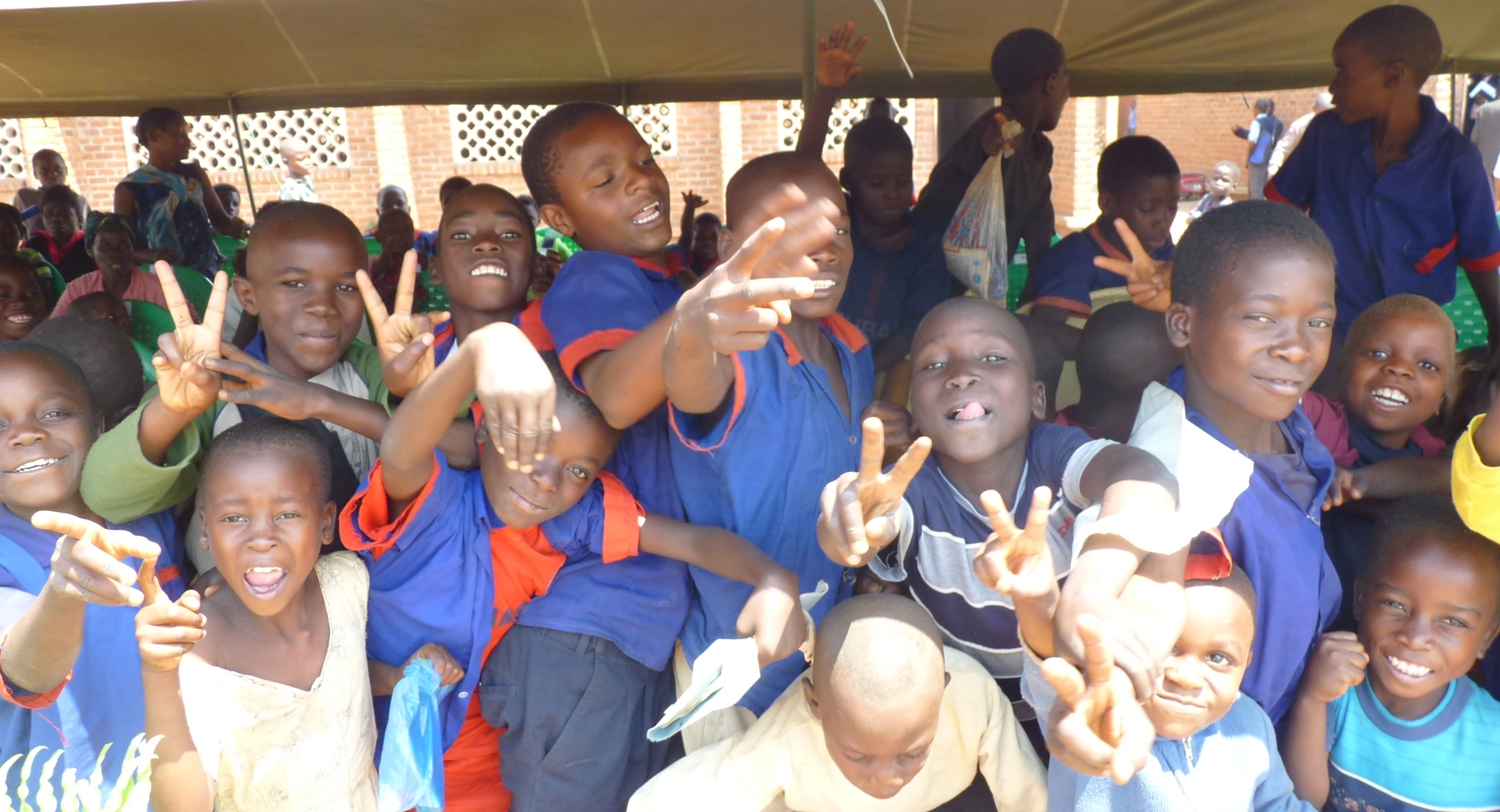
School children pose and make the ubiquitious peace sign
But others were very alarmed. They worried that something tragic could easily happen to the children, and there would be no one to be held accountable. Active facebooker Peter Kalua wrote: “Who is guiding these kids? What if they get run over, what if some of them go missing? If there is someone behind the protests of these kids, let him think properly. This is child abuse.” He spoke from a parent’s perspective and added, “I would not want to see my kid in this chaos.”

The children’s action raised several questions. How could they have left school by themselves without adult supervision? How could children from several schools have organised themselves in such an orderly way, knowing where to converge and where to head towards? But there were many others who could simply not buy the idea that Malawian primary school children could do this. There had to be someone who had organised them, for purely political gains. This was also the stand taken by the few children’s rights NGOs who spoke out on the issue.

One only hopes we will be able to get to the bottom of this and find out the truth. If it turns out that some grown-ups were indeed behind this, then it is extremely unfortunate and reprehensible. It will be frightening to see the extent to which some people can go, putting children in harm’s way just to score political points. It was already disturbing to hear one broadcasting house deliberately misrepresent and politicize the school children’s action as a protest against the teachers’ strike.

Regardless of whether these school children were organised by someone or not, there are lessons to be learned by all of us. The first lesson is that we must put in place measures for dealing with the safety and security of school children’s during strikes. Many school children understood why their teachers joined the strike, and stood with them in solidarity. But many schools left the children on their own, communicating nothing about the strike, and putting no measures in place for the children’s safety. This was a clear case of poor leadership at the school level and the strike’s organizing structures. A teachable moment was lost here.

The second lesson is that we need to become aware of the changing definitions of active citizenship and our understanding of childhood. A lot of Malawians point to the passivity and docility of us as citizens as the root causes of the socio-economic and political problems the country is facing. We have a history of expecting someone up there, be it “government” or even “God”, to solve our problems. But times have changed.

This ties into the third lesson. We need to view the discourse on leadership in our country in terms of what Malawi might look like when our school children become more actively engaged in social and political matters. Whether we like it or not, that day is fast approaching. The school curriculum teaches about civic engagement, although most schools handle this more as theory than practice. The best educational systems in the world involve school children in civic engagement and provide a safe environment for them to do so.

We cannot talk of active citizenship in the school curriculum while expecting that our children will remain aloof from and uninterested in the ills that afflict Malawian society. Children learn more than what the curriculum teaches. They learn by observing the grown-ups who surround them. We must always remember that the children are watching us, and are making their own judgments about how leaders lead. Knowing this should make us conscious about what we would like our children to learn, and what kind of Malawi we would like to bequeath to them. 

This article first appeared in the My Turn op-ed column of The Nation newspaper on Wednesday 27th February, 2013.