Thursday, November 23, 2006

Redefining ‘development’ in Malawi: beyond the pessimism

For Malawians who haven’t been in Malawi for sometime, the one question they never fail to ask someone who has just returned from the motherland is: So, how is Malawi? Being such a vague, general question, it takes some probing to get at the heart of the query: Is Malawi developing? Ten or so years ago I would have interpreted ‘development’ in a specific way: the sprouting of new, big and tall buildings, and new tarmac roads, in Malawi’s cities, towns and rural areas. In the last six or so years I have come to think of ‘development’ in different ways, to the extent that I have had problems defining it for my own purposes. A big part of that has to do with what I was reading in graduate school, in courses varying from literary theory to historiography to educational theory to epistemology, all of them gripped by what today seems more of a passing fad than a new paradigm. It is what Tiyambe Zeleza calls ‘the posts,’ propelled by what Thandika Mkandawire has called a surfeit of Western opulence, or some such term. But this should be another story for another day. Today I want to dwell on how I have retained the definition of ‘development’ as progress, as the erection of big, tall buildings, roads and other infrastructure in urban and rural Malawi (and for that matter, Africa as well). I say ‘retained’ because I have added new categories in the definition.

Development, as it is defined in general terms, is a source of both hope and frustration for many Malawians. When I landed in Blantyre on Tuesday October 31, I spent the next morning checking my email at MalawiNet’s wireless Internet cafĂ© (the wireless part didn’t seem to be working, yet). At MK60 for every 15 minutes (roughly US$0.45), it was quite inexpensive, at least for anybody who uses email as part of their regular routine. Later in the day I went to new Ryalls Hotel to board the afternoon Coachline bus to Lilongwe. The Coachline is Malawi’s top-of-the-line public transportation system between the three major cities, expensive as it is elitist. You have to be affluent in order to afford the Coachline on your own. Having never been a well-to-do Malawian, I have never been on the Coachline bus. Not even after this attempt.

I turned up at the hotel on time, and found that the regular bus that goes as the Coachline, a beautifully modeled, classily built and glitzly gliding bus that does not stop anywhere between Malawi’s major cities, had been replaced by an ordinary bus for that day. This was not even the Express bus, next in line after the Coach and also supremely comfortable. Rather, this was the third-tier type of bus, very noisy, poorly lit, and very hot on a hot November day. We were told that the 5-fleet Coachline, termed the Paradiso, was unavailable. One had been involved in an accident; one was in Lilongwe, one was in South Africa, and another one was in Zambia, under hire by the Malawi government. They refunded part of the fair, amidst groans about the degenerating standards of the bus company, and of things in general in Malawi, according to a few people I overheard. We arrived in Lilongwe four hours later, and I was taken to Riverside Hotel, next to Lingadzi Inn. Riverside is a new hotel built just months ago. It is exquisite in its white paint, beautifully designed, quiet, and magnificent. The receptionist couldn’t find my name on the list of booked guests for that day, so I ended up at a motel in Likuni. By the end of the following day the management of Riverside Hotel had faxed the administration officer of the project I was in Malawi for, apologizing for the inconvenience. They even offered an explanation, and added the latest news that they had just finished the construction of 36 new rooms, which would be ready soon. They ended the letter by saying there was room for me for that night, Room number 1.

I spent a couple of evenings in Lilongwe, driving out to surrounding rural districts during the day and returning to the city in the evening. What I saw on those few evenings fits the definition of ‘development’ used by most Malawians, including those living outside Malawi. I was curious to find out exactly who was responsible for most these transformations, and was told of Malawian Indian business magnets. Riverside Hotel is one example, as is Cresta Hotel, inside the sprawling, magnificent complex known as Crossroads, that houses shops, offices, pizzerias, laundromats, etc. (For fear of digressing, I will put aside my views about the importance of Third world consciousness and solidarity for another day)

For those who haven’t been to Malawi in the last ten or so years, the number of huge, sprawling, expensive shopping malls is something to write home about. The number of top class hotels and lodges spread all over the city is uncountable. Several of them offer free wireless Internet, despite quoting their rates in US Dollars, upwards of $90 a night. Driving out of Lilongwe during the morning and evening rush hours now takes twice the time it used to ten years ago, due to traffic jams. Many of the cars you see are spanking new latest models. The controversial Kamuzu Mausoleum is a site to behold, regardless of one’s disapproval over the use of so much money to honor a leader who victimized, murdered and exiled thousands of Malawians. It is quite ironical that it has now become quite common in Malawi today to hear people reminisce of the good old days, when there was food security, negligible crime rates, a good educational system, and a stable economy. I have written elsewhere about how I resent this whitewashing of Malawi’s dark past, and how dangerous I find this type of amnesia and nostalgia. But I should also mention that there does exist in Malawi more complicated views of Kamuzu’s reign, which do highlight both the atrocities as well as the successes of his policies and philosophies. Be on the lookout for one such forthcoming work, Reverend Stewart Lane’s Malawi memoirs, titled Peculiar Honours, to be published by Dr. John Lwanda’s publishing house, Dudu Nsomba.

In Blantyre I was only able to drive through the city on one afternoon. The same type of ‘development’ taking place in Lilongwe is also taking place in Blantyre, with lots of huge, beautiful buildings taking shape all over town. They include shopping malls, mega churches, residential houses, media institutions, educational institutions, and many others.

In Zomba, the university town I grew up in and know better than any other Malawian town or city, the general view is that there is very little of this type of ‘development’. The central business area is pretty much the same as it has been for the last ten years. There have been a few innovations, but not to the same extent as Lilongwe or Blantyre. The Zomba Central Hospital, formerly Zomba General Hospital, now has a wall entirely surrounding it. St. Charles Lwanga parish, my parish, is also putting up a wall around it. There have bee a few hotels and lodges, but only a handful. The one area Zomba is experiencing the same type of ‘development’ as the major cities is the construction of residential houses on the outskirts of the town. In Malawi, as in most countries around the world, building or owning your own home in the major towns and cities is considered, and rightly so, the most important investment one can make. The building industry has thus experienced an astounding boom, and will likely continue to. There are new, huge, gorgeous homes built and continuing to be built in the Sadzi/Three Miles area, Mpondabwino, the exclusive Old Naisi, Mangansanja and Mulunguzi areas, and the areas surrounding town, including St. Mary’s and Ndola, to a lesser extent. At Jokala, some ten or so miles outside Zomba municipality, a rural project is constructing a public library and a conference hall, away from the nearest urban center. Sports stadia, market squares, bus depots, roads and other infrastructure have sprang up in several districts, including Balaka and Dedza, among others.

If all of this does qualify to be defined as ‘development,’ there is also something I find to be quite curious and peculiar in the way some Malawians perceive their country. Whenever I have asked the question about ‘development’ in Malawi, the responses have been muted at best, and negative at worst. I have been told things such as: “Malawi is the same as you left it. Nothing has changed.” I do not recall reading anything about all these ‘developments’ either on the Malawi listservs, or in the online papers. Perhaps I haven’t been reading carefully enough. For as long as I can remember there has been an unmistakable air of pessimism and negativity amongst many Malawians, both inside and outside Malawi. Some of it stems from the notion that Malawians view themselves as “less-than” other Africans, to paraphrase the columnist Bayana Chunga in the Sunday Times of October 15, 2006. In some cases this inferiority complex is spoken in terms of Africa and the Black race in general.

During this current stay in Malawi, I’m finding myself having to discuss this complex almost on a daily basis, especially with educated, elite Malawians. Some of them are educationists, working on educational policy, training trainers of teacher professional development, and lecturers in our teacher training colleges. Most of these views are exactly the same as those one encounters, on a daily basis, on the Malawi Internet listservs and in the daily and weekly newspapers. However it must also be said that compared to 2004, when the presidency changed hands, the number of people who feel optimistic about the country’s leadership and the economic policies it is espousing is growing.

The encouraging thing about all this is that through their self-criticism and self-negation, Malawians can be said to be exhibiting high expectations for themselves, though in a converse manner. You have to turn the criticism around in order to observe the high expectations about ‘development’. In retaining the definition of development as held by the majority of Malawians, I am also aware of how narrow, insufficient, and perhaps even retrograde that definition can become. By this I mean that it is a definition based more on a scale that measures our ability to ‘copy,’ than to innovate and create new ideas, trends and products. This is a very important distinction to make. The definition of ‘development’ as buildings and infrastructure does capture the hopes and aspirations of many Malawians, but its narrowness and insufficiency comes from its inability to encourage the reconciliation of our endogenous institutions, traditions and cultures with our desire for change. Built into all our institutions of governance and social organization, ‘development’ is seen more as what we learn from other countries, especially the white societies of the global North, than what we ourselves and our fellow blacks and global Southerners create.

Our response to the question “Is Malawi developing” therefore needs to be broadened into those efforts taking place in our villages and rural centers, to include the collective and communal resource that Reverend Stewart Lane calls “social wealth.” We see this wealth every time there’s an occasion that brings Malawians together, to celebrate a wedding, to send off the departed, to elect new representatives, to build a new school, church or conference hall. In Dowa, gulewamkulu has been mobilized to support educational efforts. Whereas you would see gule chasing pupils away from school, it now escorts them to school. The conflict between tradition and modernization has existed largely due to the condescending, demeaning attitudes exhibited by educated Malawians over those considered ‘uneducated’ or ‘illiterate.’ A redefinition of ‘development’ also has to consider the changing attitudes of educated Malawians over our traditions, cultures and self-identity as a nation.

Some of what passes for development is really meant to benefit the elites and the powerful, perpetuating the gap between the rich and the poor. This is where a redefinition of the term becomes even more important.

So Yes, Malawi is developing, however you define development. And she needs your support, optimism and encouragement, in addition to your criticism, pessimism and condemnation.

Wednesday, October 18, 2006

From Material Girl to Spiritual Mum: Madonna, Malawi, and Baby David

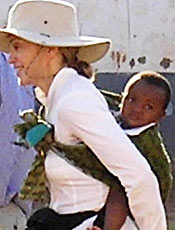
For Mr. Yohane Banda, who had never heard of the pop diva Madonna until she visited Malawi last week to adopt his 13 month-old son David, the closest he could relate with the material girl was the word Dona, meaning rich white woman, in Malawian parlance. In a matter of days, he now knows her, and the rich guy Guy Ritchie, as the new parents of his son. My initial reaction to the news was amazement at how a child whose father was alive and available could be termed an orphan, and be considered for adoption. I have since learned from youtube videos and other news articles that Mr. Banda’s first two children died in infancy, and he gave up David for fear that he too would die, after his mother died a week after his birth. The debate that has erupted over the adoption has elicited 67 webpages of comments on the BBC website Have Your Say, and is still raging on across Malawi listservs, newspapers and radio stations. As debate can sometimes be a powerful tool for social change, the views expressed by most people on the topic, in Malawi and around the world, reveal the extent of pessimism on the one hand, and optimism on the other, about Malawi’s and Africa’s future. An unspoken corollary of that pessimism and optimism is the idealization of the global North, of its material wealth and supposed happiness, and of celebrity bliss.

In Malawi and on Malawian listservs, the debate has been about two issues. First, the manner in which Malawian law has been circumvented by a High Court order, exempting Madonna from an 18-month legal residency requirement, and from a ban on international adoptions. Madonna is reported to have met with the Malawian president, Dr. Bingu wa Mutharika, but no official statement was released on what they talked about. The second point has been about whether the child would not be better off growing up in the place of his birth, while receiving whatever help Madonna and other well wishers might provide. On the BBC’s Have your Say website, a frequent refrain has been whether this is not yet another publicity stunt by yet another attention-seeking celebrity. Using the argument about the illegality of the adoption, an umbrella group representing up to 60 human rights NGOs, the Human Rights Consultative Committee (HRCC), attempted to stop the adoption by going to court, where they apparently did not succeed.

Arguments in favor of the adoption have ranged from accusations of jealousy with the bright future David will be assured of, to archaic laws that are said to contradict the spirit of the new constitution. On whether the child would not be better off staying in Malawi and being supported by Madonna without having to leave Malawi, several people have questioned the wisdom of letting a child grow up in an orphanage when adoption is available, while others have suggested that psychotherapy and counseling should be not only available in the West but also capable of helping David cope with the psychological problems that may arise out of the adoption, and out of having parents of a different race from his.

The myriad views expressed over the issue reveal various assumptions about the conflict between culture and change, the plight of a country such as Malawi and its uncertain future, and the taken-for-granted idea of the West as the best place for a guaranteed future. There can be no denying that having famous Madonna and rich guy Guy Ritchie for parents is going to give David a growing up experience totally different from one he would have in Malawi. He will be afforded the best schools in the world, the most expensive clothes and toys, and the world’s attention. What is not easy to predict, however, is whether wealth, fame and status are going to be enough to guarantee him happiness, satisfaction, and a meaningful life. Many of those who have supported the adoption have not even thought of this as an issue; to them, there is no question that wealth, fame and a ticket to the global North are the best guarantee for happiness and life satisfaction, and a place like Malawi is the last place anyone would want to grow up in, given a choice. Given that Malawi now has about 1 million orphans, the high infant mortality rate, inadequate health care services, a struggling school system, recurrent famines, etc, it is not difficult to see why many believe David will have a much better future growing up as Madonna’s child, in the global North.

It is worth celebrating that today Malawi’s orphan population has been somewhat reduced, and that one of her children has the once-in-a-lifetime chance of becoming a globally recognized face. But the plight of the other 999,999 orphans still needs long-term solutions. Madonna’s NGO in Malawi, Raising Malawi, is going to take in 4,000 orphans. Given the publicity the adoption has raised, it has already been reported that the government ministry responsible for women and children is being inundated with telephone calls from around the world from people who also want to help with the orphan problem. Thus many are only thankful that Malawi has been in the news around the globe, thanks to Madonna.

Out of the millions of views that have come out pouring on the topic, the question of whether life in the global North is qualitatively better than in poor parts of the world has not come up as prominently as one would hope. Schools in the global North can be excellent, but they can also spawn deadly violence, as seen in the several school shootings that occur frighteningly frequently in the United States and other “developed” countries. Black people in majority white societies live under the constant fear and threat of racism and psychological, sometimes physical, violence. The American comedian Chris Rock has argued that he might be a very rich black person, but no white person, however poor, would willingly change places with him.

A lot of educated Africans grow up to despise and dismiss their African identity, accepting the received wisdom of the inferiority of the black person (except themselves personally) and the supposed superiority of the white race. Perpetuated through school knowledge, these beliefs pervade our minds to the extent that we come to see Africa as a place set apart from the rest of the world in terms of development, civilization, technology, and wealth. We come to think of Africa as stagnant, unchanging, and forever backward. It is a tragic truth that many Africans have lost hope in the struggle to solve Africa’s problems, and now adopt white supremacist views on their own identity and destiny.

Although their actions have been interpreted as jealousy and anachronism, the Malawian lawyers and activists who have drawn our attention to the way in which Malawian law has been compromised for the sake of a celebrity adoption have shown that not every African has been sold on the white supremacist bandwagon. Granted that there are NGOs who thrive on foreign money which they misuse and enrich themselves with, there are Malawians who are genuinely concerned about Malawi’s problems, and are working both inside Malawi itself and outside, to help ease the problems. The very Malawians who are making accusations of jealousy and archaic laws would be the first ones to blame the Malawian legal system the moment child traffickers learned of the power and influence of money and fame, and began targeting Malawian children. Hopefully this debate has alerted us to such a possibility, and we are embarking on a process to make sure it does not happen.

All said and done, the future of the world does rest on our ability to deal with the race problem, and Madonna’s act could be seen as one example in that direction. As she told Merle Ginsberg of the pop culture and fashion magazine, W, in the April 2003 issue, she sees it as her “responsibility […] to bring light to the world and make the world a better place.” For us Malawians, we will need to think deeply about the breakdown of our social and communal institutions, which in the not-too-distant past used to be strong enough to handle problems of orphanage. Thanks to the fluctuations and unpredictabilities of globalized economies and inequities, our safety nets are gone, and our desperation is tearing us apart. Yet, we have been able to deal with change before, and although it is undoubtedly going to be very difficult, I do not see why we cannot, in the long run, and with the support of our friends, deal with the coming problem.

Wednesday, October 11, 2006

Desmond Tutu, Bill Clinton and uMunthu

I first drafted this entry more out of an urge to vent, than to reflect. I had difficulty writing about an airport ordeal and connecting it to the African Renaissance and Black Consciousness, until I learned of the recent remarks made by Nobel peace laureate and retired Archbishop Desmond Tutu, and former US president Bill Clinton. Archbishop Tutu has decried the moral depravation in South Africa, a breakdown of uMunthu, whereas Clinton has adopted uMunthu (uBuntu in South Africa) and offered it as an important tool in dealing with the world’s problems. Clinton was speaking at the Labour Party convention in the United Kingdom in September. What I present below is an attempt to grapple with the dilemma of uMunthu and self-criticism in Africa, in the context of an airport ordeal I was subjected to at Johannesburg International Airport recently. It wasn’t until I heard Archbishop Tutu’s remarks that I began making sense of my ordeal and what the former Archbishop fears is happening in South Africa.

Archbishop Tutu has been one of the chief advocates of uMunthu as a philosophical framework informed by theological and social urgency in South Africa’s political transition. Lately he has been critical of the moral direction South African society is taking. Delivering the Steve Biko Memorial Lecture at the University of Cape Town recently, the Archsbihop is reported as saying: “The fact of the matter is we still depressingly do not respect one another. I have often said black consciousness did not finish the work it set out to do.” What he said on this occasion made me wonder if my ordeal at JNB was not a manifestation of the problem he was describing.

Because of the flight connection I missed from JFK to Johannesburg International Airport (JNB), it was my expectation that my luggage, two big bags containing my clothes, books, gifts, etc, would not arrive on the same flight with me at Kamuzu International Airport (KIA) in Lilongwe, Malawi. So it was not a surprise that I landed on Malawian soil without my two bags. The lodge I was staying in kindly offered to collect the luggage from the airport and bring it to my room. The person from the lodge who went to collect the luggage called me from the airport and said he was not sure if he should go ahead and pick up the bags from the carousel, given the condition the bags appeared to be in. One of the bags came off the belt half opened, with things rummaged and appearing as if some had fallen out. He asked if I had locked them both, and I told him no. I had been instructed not to lock them back in Lansing, as airport security in the United States opens and unlocks all checked in baggage. If I was going to report anything missing, he suggested I come to the airport myself and sort things out.

When I got to the Lost and Found section at KIA, I found both bags zipped close. I opened them and could not immediately tell if anything was missing. It took me a few seconds to begin recounting in my mind the things I had packed. It took me days to sort out exactly what was missing. Most of them were gifts, ie, clothing, lotions, perfumes, etc. Almost half the contents of one bag were missing.

I decided I would submit the pilferage form at the responsible airline’s baggage office in Johannesburg, on my way back to the US, rather than in Lilongwe or Blantyre, as I did not have enough time to spare in Malawi.

So on Saturday afternoon, September 16, I landed back at Johannesburg International Airport, and proceeded to check in for my connection to New York’s JFK, via Dakar, Senegal. I tried using my sense of direction to identify the section dealing with lost baggage, before realizing that I was only succeeding in getting myself lost within the airport. An airport official advised that I needed to check with immigration if they could allow me to the said section, as that was in-country. I got to what I took to be the immigration area, and was told that I had gone beyond the immigration point and needed to go back. I retraced my steps, and presented myself before the nearest station. An immigration officer stretched out her hand for my passport and boarding pass, and I handed them over. “You are not a diplomat! This is for diplomats only,” she shouted, before punching a number of keys on her computer keyboard. “It says up there clearly—For Diplomats,” she continued. “I didn’t see it, I’m sorry,” I replied.

“Did you overstay?” I told her I had just landed, barely an hour ago, from Malawi, and I was in transit. “Then how come you went beyond this point? You have entered the country. You shouldn’t have passed this point!” She was now shouting even louder and gesticulating angrily. She called out to another woman and, as far as I could tell from her tone and gestures, she lashed out at her for not watching the entry point. The other woman came over and asked me the same questions the first woman asked. “You entered the country illegally. We charge 3,000 Rands for that.” As far as I knew, I had barely moved from one side of the international departures lounge to another, and here I was, being accused of being an illegal immigrant in South Africa! I told them I didn’t understand what the fuss was all about, I was just trying to get to Lost and Found and report missing items. They weren’t impressed. They went ahead and stamped my passport, before one of them ratted out fast instructions on how to get through immigration and find Lost and Found.

All through the harangue and rudeness I did my best to stay calm and not answer back in anger, something I have recently come to realize I have great trouble doing at times. I decided I would try filing the report in New York, if I was able to get that far.

I was raging inside as I walked away from the immigration, resisting a strong urge to go back and make myself clear, so to speak. For reasons I doubt I have the clarity of mind to articulate, I became aware that I was repeatedly asking myself a series of questions: What happened to the African Renaissance? What happened to uMunthu? What happened to Black Consciousness? To African and Third World solidarity? What does any of this have to do with any of the above questions? I wasn’t going to find answers to these questions, until four weeks later, through the serendipitous occasion of the 75th birthday anniversary of Archbishop Desmond Tutu.

In reconstructing my worldview around concepts such as the African Renaissance, uMunthu, Black Consciousness and Third World solidarity, I have found myself rethinking some of the easy urges we have acquired from the Western school system. In particular, I am talking about the tendency by us elites and educated Africans to be overly critical of other Africans, African institutions, African governments, African cultures, sports, education, and even politics. I am not talking about genuine criticism that has indeed been central to the understanding of some of the causes of our problems, and to the transitions we have embarked on. Rather, I am talking about criticism spawned mainly by the underlying tendency to see ourselves as Africans and everything African through the perspectives of Northern global dominance and ideologies, long hand for white supremacy. In this regard, an easy reaction to the experience I was subjected to, from the missing luggage to the incomprehensible charge of being an illegal immigrant in a lounge at Johannesburg International Airport would have been to say that’s how Africans conduct their business—inefficiency, incompetence, and even rudeness. In fact that’s what I saw and heard several white passengers saying when their luggage didn’t arrive with them in Johannesburg from New York. No one needs to be reminded how common it is to associate Africa with incompetence, and Europe and America with efficiency.

But because of my sensitivity to such insensitivity about Africa, I refuse to subject Africa to such comparisons, realizing that incompetence and inefficiency happen even in those places considered highly developed and “civilized”. Thus on the surface, the problems of luggage missing, rude immigration officers, planed being late, etc, should not be seen as peculiar to Africa only. As a matter of fact, I missed my connection on my way to Malawi because an American plane was delayed at an American airport. I experienced another delay on my return flight from New York to Cincinnati. The air hostess apologized by saying “It’s JFK; what else can I say?” Upon which one passenger responded: “You need say no more. It’s JFK.” And another one: “That’s all you need to say.”

On the face of it, it appears futile, if not irrelevant, to spend time highlighting cases of incompetence and inefficiency in the global North. Many people would say these happen few and far between in the North, whereas in Africa they are the norm. In my view, that type of thinking is indicative of the very mentality I am decrying here, the tendency to associate excellence with the North and backwardness with Africa and the global South. For me, making the African Renaissance work involves challenging these stereotypes and encouraging people, Africans and friends of Africa, to be sensitive to unfair and unjust portrayals of Africa. uMunthu accepts criticism of Africa and her problems, but not when launched from white supremacist ideologies, as if often the case, by both Africans and friends of Africa.

Given what I was subjected to at Johannesburg in September, I agree with Archbishop Tutu’s appeals to Black Consciousness and uMunthu. However it is also incumbent upon the media to be more analytical and present the social context in which Africa is viewed in the global sphere. I often worry when important Africans give aid and comfort to anti-African agents by offering them language with which to actualize their prejudiced views of Africa. But in advancing our uMunthu worldview, one difficult question is the extent to which we should restrain ourselves from self-criticism for fear that it will be taken advantage of by racists, Afro-pessimists, and other agents of anti-Africanism.

Adding on to Clinton’s exhortation for the world to embrace uMunthu, Dr. Kennedy Lweya has opined that uMunthu as a “concept has a powerful meaning and potential to transform the world into one of better understanding and respect for every human being - it is about treating others as we would [want] to be treated.” It is in this spirit that we see the number of scholars who are researching, writing and publishing on uMunthu growing, in Malawi, South Africa, and other African countries. Lesser known than their South African counterparts, Malawians who have advanced this scholarship include Harvey Sindima, Augustine Musopole, Gerald Chigona, Richard Tambulasi, Happy Kayuni, and a few others. Anybody wishing to avail themselves with how uMunthu looks like, and why its scholars believe it has the potential to contribute to a different understanding of the world's problems, would do well to consult these and other scholars.

Sunday, August 27, 2006

Homeless in New York City

Having missed my connecting flight from JFK in New York City to Johannesburg, I have found myself homeless in the city that's open 24 hours. But even more striking for someone with my worldview are the numbers of homeless people on the streets of New York City, well known as capitalism's freemarket capital of the world. Homeless people are literally every where, on the sides of the streets, sleeping on cardboard boxes in juxtaposition to the world fame of The Empire State Building, Madison Square Garden, and the Penn metro station.

I lay no claim to having discovered homeless people in the world's largest and most well known city, as these issues have been written about by countless journalists, academics, fiction and non-fiction writers before. However I can't help asking myself how come with the unparalleled advancement of capitalism and wealth creation, this great city, and many others, cannot find a lasting solution to human desolation and homelessness? I saw similar conditions in downtown San Fransisco, another great American city, in April. And homeless people are to be found in many major cities around the world. We have homeless people even in Malawi's major cities, Blantyre and Lilongwe, but the reality is that the bigger and wealthier the city, the worse the problem.

The systemic conditions that lead to problems such as these are the same conditions that rendered me homeless last night. The captain kept announcing that we were waiting for clearance from air traffic controllers at JFK to depart Cincinnati and head for The Big Apple, as New York City if fondly called. Our flight was supposed to leave Cincinnati at 2.12pm, but we didn't leave until 3.12pm. The confusion and sprawl that is JFK International Airport meant that I had to move from our landing terminal, get onto the AirTrain, and find the terminal for the flight to Joburg. As my luck would have it, the gate number printed on my ticket, 25T, does not exist at JFK, as I later learned after half an hour of moving from terminal to terminal.

Finally, I found the desk of the airline I was supposed to connect with, and I stood there for another hour, waiting for somebody to come and attend to me. When she finally came, she told me the desk had closed for the day. She advised me to go back to the original airline that booked my ticket to rebook. There I asked where they would put me up for the night, and I was told the airline had no control over air traffic control, and it was not their responsibility to pay for my accommodation. I was forced to part with a considerable amount of the little money I had just to find a prison-cell sized hotel room in downtown NYC, near famous spots such as Broadway, The Empire State Building, and Madison Square Garden.

With the most recent restrictions on what you can and cannot put into your carry-on luggage, this means buying a fresh tube of toothpaste, which you will use once and throw away as you can't take it with you on the plane. The same goes for liquid deodorant, for those of us who sweat like pigs at an open air show.

In the capitalist world, you can pretty much be on your own if you are poor, in a system whose grip and control on your life determines every move you make. The systems are all interconnected--airlines, air traffic controllers, hotels, the metro, but once you are out in the lurch, and you are not wealthy, you can be dumped by the very system like a bag of trash from a skyscraper. The very system that leaves you desolate in a big city like NYC is the very one that creates the many homeless people bundling themselves up on the sidewalk, drenched from the midnight drizzle of August.

Sooner or later I'll land on Malawian soil, and will witness exactly the same phenomenon, a system in which a few people manage to get ultra rich, the majority ultra poor. Since we are all trained to attribute success to individual effort, and desolation to individual lack of, the giant wheels will keep turning, fulfilling the biblical promise that the poor will always be with us. Only, in my case, the poor will always be us.

Tuesday, August 01, 2006

Dear Professor Zeleza,

This is in response to your recent blog entry that presents a much needed historical perspective on the current Arab-Israeli conflict. A Sunday July 30 CNN question of the day asked viewers to email in their comments on whether they felt it was “now” time for the US government to call for a ceasefire. I’ll be lying if I say I was shocked by the blatant bias in CNN’s question, clearly regurgitating the US govt’s position in refusing to call for a ceasefire so as to allow Israel to continue massacring innocent Lebanese and destroying their country, on the pretext of disarming Hezbollah. What I found outrageous was that CNN assumed that the US government’s position was the same as their viewers’ position, who include a global audience. That’s what I have found most disturbing, that the mainstream is calculatedly presenting the Euroamerican perspective, attempting to mislead a worldwide audience into believing that an Arab position in this conflict is not only illegitimate, it is probably non-existence—just a base instinct to wipe out Israel without any provocation, without any historical grievances.

Your analysis goes well beyond the rehearsed position spat out by the mainstream media and by so-called political leaders who claim that the whole conflict was started by Hezbollah’s abduction of two Israeli soldiers. I have not seen one single news source or Euroamerican politician or pundit acknowledge that Israel’s continued illegal occupation of Arab territory is an injustice that is as much cause for the conflict, as it needs to be addressed. In fact Noam Chomsky, nobel laureates Harold Pinter and Jose Saramago, and other activists have pointed out that Hamas’ and Hezbollah’s abduction of the said Israel soldiers was in fact a retaliation for Israel’s abduction of two civilian Arab brothers the previous day. And according to Tanya Reinhart, an Israeli professor of linguistics at Tel Aviv University, Israel has in fact been preparing for a “massive war on Lebanon” for several years.

The only consolation I find in this whole crisis is the ability by several Israeli scholars and citizens to condemn their own government for the atrocities it is committing against its Arab neighbors, pointing out that Israeli aggression over the years is a major cause of the decades-long conflict in the middle east. Several Jewish activists have been courageous enough to stand up and declare their condemnation for Israel, pointing out that rather pretend to criticize both sides equally, they side with the victimized, the oppressed and the colonized. Some have even been demonstrating in the capital Tel Aviv.

Much as some would like the world to believe that European imperialism ended decades ago and that current world problems have nothing to do with the legacy of European colonialism, it is worth pointing out, as you do, that the origins of this particular lie in European anti-Semitism and racism. The task of educating people ignorant of this history is frighteningly huge, given the prominence of CNN, the BBC, Reuters and other mainstream news sources whose EuroAmerican biases prevent many from learning the truth. I’m nevertheless optimistic about the possibility of a greater awareness of the root causes of many of these conflicts around the world. Those Jewish and Israeli activists able to overcome the disinformation campaign and the kindred triumphalism, choosing instead to promote solidarity with the global South and the “wretched of the earth”, give me much hope.

Tuesday, July 11, 2006

Zizou’s issues: football’s aesthetics vs. global ethics

Who would have predicted that on the morning after the grand finale of Germany 2006, and in the days to follow, much of the world would be debating a headbutt and its probably or allegedly racist provocation? The issue has divided people’s opinions, with some believing that the reputation of the game solidly rests on the upholding of a virtue called “sportsmanship,” in which a player should not react to a provocation, however insulting. Others contend that as long as it fails to address the problem of racism head-on (pun coincidental), football as a game does not deserve the attribute of being a beautiful game. Regardless what side of the debate you are on, the incident makes one thing clear: football is more than about athletic aesthetics and kinesthetics. It is also about global ethics and responsibilities in addressing problems of racial injustice and historical inequality. These problems are evident and in need of attention, even if it turned out that Matterazzi’s comment to Zinedine Zidane, popularly known as Zizou to his fans, was benign, if not amiable.

Those who see the game as being more about sportsmanship and athletic aesthetics than about global ethics insist that the best reaction to a provocation on the field is referring the matter to the referee, rather than responding to the provocation. The issue of not responding to provocations has been a defining problem for individuals and groups dealing with problems of social justice for many centuries. It may be said to share philosophical turf with ideas such as non-violence and the biblical ethic of turning the other cheek. Some movements based on these precepts have been successful, but others have merely worked to the advantage of the powerful and privileged, leaving the concerns of powerless and underprivileged groups unattended.

From the perspective of sportsmanship and athletic aesthetics, Zidane should have kept his calm and reported the matter to the referee. But this perspective ignores the question of whether the referee would have believed Zidane, having not been within earshot of the incident. Would the world have believed Zidane? A non-response from Zidane would have in fact meant that the only sound to be heard the morning after would be the deafening cacophony of Italy’s triumph. Would a complaint about racism, in a world in which racism has sometimes been blamed on the victim, have any chance of being heard in such a triumphalist din?

Another point being made is that a non-response reaction to a provocation on the field would have been more appropriate considering that the behavior of sports stars on and off the field has a huge impact on young people worldwide. This is also a good point to make, but it subordinates the problem of racism as being less important than the need to provide young people with impeccable role models. Subordinating the problem of racism to the backyard of perfect, spotless role models strikes me as not only immoral, but also unrealistic and misleading. Do we really expect young people to be that uncritical? Even if we accept that many young people are indeed uncritical and buy wholesale into the myth of the perfect sports star or celebrity, is that the kind of worldview we want to encourage in our young people? For how long are we going to sweep under the carpet the problem of racism and injustice in world football?

The problem of racism should not be seen as superficial and merely having to do with the temperament of players on the field only. It should be seen as a more profound problem, affecting the hopes and aspirations of billions of underprivileged people around the world. It should be seen as representative of the other intractable issues that have so far not been given prominent attention, including the fact that this was another all-Europe affair in which Eurocentrism as both an ideology and reality was on display yet again, as far as the hosting of the tournament, the slots per confederation, and FIFA’s selection of the best 23 players of the tournament. While the diverse ethnic and racial makeup of the French team was one indication of how racism can begin to be overcome in the very heart of Europe itself, that observation is, for the moment, being buried under superfluous condemnations of an act that may have been the culmination of years of pent up rage, as alluded to by those more familiar with Zidane’s experiences growing up and the larger problem of racial integration in French society. This is not a perspective that can be easily understood by some ensconced in the racialized privilege and class comfort of material surfeit.

Rather than seeing Zidane’s headbutt as an ugly act tainting the reputation of a so-called beautiful game, it should be the pervasive racism of European domination of world football that is truly ugly. The beauty of the game should not be seen in terms of aesthetic and kinesthetic displays on the field only. It should also be seen in the actions FIFA takes to make the game live up to that attribute by being an instrument of active world peace and global social justice. With South Africa 2010 on the horizon, one hopes we are heading in that direction.

Monday, July 03, 2006

African football, global inequality and 2010

Much of the African media’s analyses on the reasons why no African team went beyond the second round at the ongoing World Cup Finals in Germany focus on one theme that reflects much of the African media’s analysis of Africa’s problems: self blame. Virtually no analysis I have so far looked at mentions broader issues of global, historical and political injustice and inequality, in how world cup berths are allotted in the different FIFA confederations. In fact, a Rwandan columnist repeats a common refrain about how Africans always blame colonialism for their ills, when no such thing has even been mentioned in any of the analyses and comments, whose uniting feature has been blaming African teams for lacking self-confidence and resources. Such is the strength of the reluctance to examine African problems in their broader context that blaming colonialism is considered not only taboo, it is brought up even when nobody mentions it.

In Malawi, The Nation newspaper of July 1 quoted national team players, sports commentators and coaches as saying African teams lacked tactics and “failed to properly read issues on the pitch and react quickly.” Another player blamed it on lack of self-confidence, saying African teams gave a lot of respect to the more experiences teams. The Zambian paper The Post quoted the Nigerian coach Augustine Eguavoen as attributing the problem to lack of experience, while the Business Day of South Africa quoted Farouk Khan, youth development coach, as saying it boiled down to lack of facilities to promote the sport in Africa. The Zimbabwean Independent put their finger on “naivet.” There is no denying of the validity of each of these issues.

However, in addition to these analyses, I want to suggest a deeper examination of historical and political trends apparent in the development of the game since 1930, the first time that the world cup finals were staged, in Uruguay, South America. With the exception of Japan and South Korea in 2002, the world cup finals have always been played in two regions, Europe and the Americas. Is it much wonder, then, that the world cup has always been won by teams from these two regions, and never from any other region of the world? To date, after 17 world cup tournaments, in a period of 72 years (as of 2002), only 7 seven teams in the world have ever won the FIFA World Cup, all of them from either Europe, or South America. Is it such a big surprise that these two regions boast the world’s most accomplished footballing nations, and that other regions do not have such pedigree?

The inequality and injustice of the game’s organization is even more blatant in the way world cup finals slots are apportioned. The continent of Europe has 51 national football associations, and has 14 (15 in 2002) world cup finals slots. Africa, which has 52 member associations, has only 5 slots, an improvement from 1978 when Africa was accorded only one slot. South America has 10 associations, yet it claims 5 world cup places. Asia, with 44 associations, has 4 places, while Oceania, with 11 associations, has no slot of its own, relying on a victory in a play off with the 5th placed in South America to be accorded a slot. Unstated in these allocations is the fact that some of the teams that are accorded national status in FIFA are not even sovereign nations. Examples include Scotland, Wales and Northern Ireland, teams that do not have nation status at the United Nations, yet they are accorded the opportunity to compete with a 3 to 1 chance of making it to the finals over sovereign African and Asian nations. This not an argument against these teams’ world cup berths; rather, it is an argument against the injustice and inequality facing African and Asian nations.

To its credit, FIFA has been more open and accepting to demands from the Confederation of African Football (CAF) for more places and support, thanks to the two FIFA’s presidencies of Joao Havelange, a Brazilian, and Sepp Blatter, a Swiss, who is the current president. According to Paul Darby’s (2002) study of the development of football in Africa, politics and colonialism have been apparent at each turn of the game. In his book titled Africa, Football and FIFA: Politics, Colonialism and Resistance, Darby argues that the contours of the development of football in Africa reflect the struggles of African countries in global politics and history. Writes Darby: “Africa’s position within FIFA’s global hierarchy can be illustrated and informed by drawing upon explanations which take into account of the globalization of culture, economic models of global development and a range of perspectives in international relations” (p. 7).

Darby’s framework and approach, which lead him to conclude that Africa has contributed a lot to world football, is shared by other researchers, including Alegi (2004), Cornelissen (2004), and several others. This is why I find it intriguing that much of the commentary in the African media says nothing about the broader contexts in which African football has to dribble and tackle. It does not take sophisticated thinking to understand how more opportunities to play in the world cup finals translate into improvement of the game back in the region accorded those opportunities. The self-blame train, interestingly, does not see this point.

There is much to be admired in the tendency for us Africans to blame ourselves, contrary to those who claim that Africans like to blame others. However there are broader contexts that must be taken into consideration, to make the analysis more accurate. A lot of the self-blame can in fact be seen as coming out of the inferiority complex that is widely, and perhaps correctly, understood to plague many Africans, who never cease to see Europe and America as the unmatched epitome of civilization and advancement. Some of the self-blame also comes from an attitude of Africans’ dissatisfaction with conditions in their own countries, unbalanced with an acceptance of the status quo at the global level. These are effects of a Eurocentric mindset, in which these particular Africans, mostly from the elite ranks, have been schooled to view themselves through European worldviews.

After several shots from the penalty box, Africa has finally scored into the goal of the hosting rights to the 2010 world cup finals. A few commentators have observed that Ghana’s performance in Germany has been worthy of world cup finalists, and that to those who have followed Ghanaian football, this has not been a lucky flick. Whereas hosting the tournament on African soil does give African teams an added boost, the reality of five slots, against historical domination and slot advantage from Europe and South America, does not offer much hope for an African team winning the cup. Africa’s victory lies in the gradual triumphs registered so far, a reflection of the awareness of the inequality and injustice of not only the world game but global relations as well, on the part of Africa’s struggle leaders and other fair-minded individuals around the world.

Saturday, June 17, 2006

Soweto smoke, 30 years on

For the youth of today

The earth need not be hungry

Swallowing sweat

Dripping from bruised brows

Winds beating upon backs

Still firm and strong

For the youth

The earth need not be so dry

For our earth is nurture

And the road ahead

Demands stamina

Beyond textbook falsity

For us

Who dare to imagine

The many Soweto Uprisings

Still raging in our backyards

Shadowed in the backdrop

By gated kingly mansions

The earth is not only hungry

It is also angry

For why would our youth

Whiz through suburbia schools

Attain shrill-sounding degrees

Globe-trot in first world offices

Yet know nothing about Biko?

Nor Nkrumah

Nor Malcom X & DuBois?

And still think themselves

Elites

More deserving

Than the hoodlums of Ndirande?

On this day of the African child

Thirty odd years after June 16, 1976

Tell the youth the truth

And let the earth mend

From this deathly thirst

Parching throats

And frying minds.

© S. Sharra Mlauzi, June 16, 2006

Saturday, May 20, 2006

Malcolm X and pan-Africanism today

Today, May 19th, marks Malcolm X’s 81st birthday. It is sad to observe that 41 years after his assassination on February 21, 1965, the pan-Africanist awareness and consciousness that Malcolm celebrated on the continent are dead, at a moment when they are in fact needed most. What happened to such a promising start? What can we do today to make pan-Africanism once again the ideological force that it once was?

When he visited the continent of Africa twice in the last twelve months of his life, Malcolm X followed in the footsteps of Dr. WEB DuBois in demonstrating how, to paraphrase his own words, the struggles of African Americans in the United States, and those of Africans on the continent, were “interlocked.” Malcolm X’s visit, which followed the settling in 1961, and eventual death in 1963 of Dr. DuBois in Ghana, was a key moment in the history of pan-Africanism. Malcolm X believed in internationalizing the African American struggle against racial injustice and inequality in the United States, which he suggested ought to be a human rights issue, above and beyond being a civil rights issue. He saw the support of Africans on the continent as key to achieving this heightened awareness of the struggle. Malcolm was able to hold this view for the specific reason that on the African continent itself, pan-Africanism was very much alive and thriving, with Africans exhibiting an acute awareness and a global consciousness of the struggle needed to liberate Africans on the continent and in the Diaspora.

Malcolm X visited the continent of Africa for the first time in his life in May, 1964. He had just finished his Hajj, or pilgrimage, to Mecca, where he changed his name to El-Hajj Malik El-Shabbaz. He was to return to the continent later that year, and stayed for 18 months. The two trips took Malcom X to several countries in Africa, including Algeria, Morocco, Egypt, Nigeria, Ghana, and Senegal, among others. He was able to meet and have private audiences with presidents of several countries, including Gamal Abdel Nasser of Egypt, Julius Nyerere of Tanzania, Nnamdi Azikiwe of Nigeria, Osagyefo Dr. Kwame Nkrumah of Ghana, Sekou Toure of Guinea, Jomo Kenyatta of Kenya, and Dr. Milton Obote, then prime minister of Uganda.

In his autobiography, as told to Alex Haley, published in 1965, Malcolm X repeatedly spoke of how his whole life had been about constant change. Born on May 19, 1925, he grew up very poor, and lived in Lansing, Michigan, the very town I am writing this from. His father, Rev. Earl Little, a Baptist preacher, was murdered by the Ku Klux Klan here in Lansing, in 1931, for his active involvement in the Marcus Garvey back-to-Africa movement, known as Universal Negro Improvement Association (UNIA). Malcolm was six years old at the time. After eighth grade, in which he was voted class president, in a white-dominant school, he moved to Boston, Massachusetts, where he worked menial street jobs, and led a life of crime selling narcotics, pimping, and armed robbery. He was later arrested with a colleague, and served 7 years of a 10-year sentence.

In prison, Malcolm discovered the library, and became a voracious reader. He took classes taught by instructors from Harvard and Boston Universities. He participated in debates, and imprived his writing ability. He read HG Wells, WEB DuBois, Carter G. Woodson, JA Rogers, Gregor Mendel, and many other scholars, on topics including world history, world civilizations, religion, genetics, and linguistics. One of his brothers told him about The Honorable Elijah Muhammad and the Nation of Islam, which he later joined and became its strongest and most steadfast disciple. He became second in command to Elijah Muhammad, and his faith in the religion was deep and unshakeable. He was responsible for the growth of The Nation of Islam, from a gathering of about 400 to a national movement of more than 40,000 people. He made speeches across the United States, in which he spread Elijah Muhammad’s message that all white people were devils, created to contaminate the world and rule it for 6,000 years; and that black people, created a superior race, would soon take over and rule the world again. Beyond the black supremacist and racist ideology of the Nation of Islam, Elijah Muhammad and Malcolm X represented an unparalleled deep understanding of the fundamental basis of the white racism that kept black people in America down and relegated them to a life of misery, injustice and ignominy. They did this at a time when most black people did not even have the courage to speak truth to power and teach whites about the disastrous consequences of racism unto African Americans. Later Malcolm was shocked beyond belief to uncover immoral acts committed by Elijah Muhammad. When he consulted Muhammad to find out how to deal with and contain the breaking scandal, Muhammad turned against him, and sought ways to restrict Malcolm. Muhammad’s opportunity came when, reacting to the assassination of President John F Kennedy on November 22, 1963, Malcolm X remarked that the violence that the US government had inflicted in different parts of the world had come back to haunt it. “The chickens have come home to roost,” said Malcolm X.

Elijah Muhammad suspended Malcolm from his position, and their differences grew. Malcolm made his pilgrimage to Mecca, which exposed him to the larger, original and authentic Islamic faith. During the pilgrimage, Malcolm mixed, mingled and prayed with Muslims from different ethnicities and skin complexions. While there he received honor and respect from people who looked as white as the white racists in America, something that he had never experienced in the United States. That began for him what was to become a profound, cosmic change in his worldview, in which he began to question his black supremacist ideology. Malcolm did not lose sight of the racism that black people continued being subjected to in the United States, but he was now able to see the positive role that white people could play in helping end racism. His thinking in this matter was most incisive and prescient, as he states in his autobiography:

"I said that both races, as human beings, had the obligation, the responsibility, of helping to correct America’s human problem. The well-meaning white people, I said, had to combat, actively and directly, the racism in other white people. And the black people had to build within themselves much greater awareness that along with equal rights there had to be the bearing of equal responsibilities" (Autobiography, p. 375, 1964).

He adds: “I knew, better than most Negroes, how many white people truly wanted to see American racial problems solved. I knew that many whites were as frustrated as Negroes.”

Malcolm X’s activism, both before and after the Hajj, was well known even outside the United States. In Africa he was as relevant to the struggle for independence as the other nationalists on the continent. His wish was for more black Americans to develop a greater awareness about the inter-linkages between their struggle and that of other black people on the continent. To a certain extent, that wish has been achieved in some sections of the black community in the United States. In Africa, one can’t help but feel that the awareness of the importance of pan-Africanism and the trans-Atlantic linkages of the destinies of black people around the world has been dying a slow death. Today, very few African leaders even address the issue. Very few African students from primary school to university have any idea about pan-Africanism, let alone Malcom X and what he stood for. The most obvious consequence of this can be seen in the discourses of the elites in discussing current affairs. Most of the discussion focuses on the heat of the moment, with very little historical, informed analysis of the broader contexts that keep churning out one crisis after another, as is the political situation in Malawi today. It has not always been like this.

In his autobiography, Kanyama Chiume (1982), one of the leading nationalists in the struggle for Malawi’s independence, writes about the continent-wide pan-African network that provided nurture and support to most countries fighting for independence. Serving as Malawi’s foreign minister up to the time Malawi achieved independence, Kanyama Chiume’s travels around Africa connected Malawi’s struggle to those in Algeria, Tunisia, Ghana, Guinea, Tanzania, South Africa, and many other countries. Malawi received support, financial, strategic and otherwise, from India, Egypt and other countries who were also fighting imperialism and colonialism. Chiume writes about meeting and discussing the African struggle with Algeria’s leader Ben Bella, Egypt’s Nasser, Ghana’s Nkrumah, Guinea’s Toure, Tanzania’s Nyerere, among others.

It is not too late to revive and re-energize the pan-Africanist ideals of African unity, as preached by John Chilembwe, WEB DuBois, Malcolm X, Kwame Nkrumah, Julius Nyerere, Frantz Fanon, Sekou Toure, and many others. I wish this message had received wider media attention when Malawi’s president Dr. Bingu wa Mutharika invited, and named a road after, Zimbabwe’s President Robert Mugabe earlier this month. While a lot of the criticism against the visit and the road-naming was based on Mugabe’s human rights abuses in Zimbabwe, none of the criticism, including and especially newspaper editorials, exhibited any pan-Africanist consciousness and awareness, choosing, instead, to toe the Euro-American line and thereby perpetuate the fatalist, dependency syndrome designed to ensure that Africa is forever shackled to imperialism. This has to change. And we must begin with the young people, who hold the promise for the future.

Friday, May 12, 2006

Bob Marley and the continuing struggle for global justice

I was in Standard 8 when one of my mother's brothers, William Ziwoya, or Godfrey Ziwoya, as he later insisted on being called, came to live with us at Police College, in Zomba. Uncle Godfrey, who was 7 years older than me, sadly died in 2000, aged 36. In his short life, he taught me two things, one of which has had a defining influence on my worldview. Uncle Godfrey loved reggae music, and considered Bob Marley to be the greatest musician of all time. He also loved Bruce Lee, and considered him to be the best martial artist of all time. His love for Bob Marley influenced me so much that I not only came to also see him as the most important musician of all time, I have actually come to adopt his pan africanist social justice agenda as my guiding worldview.

Today, May 11, 2006, marks 25 years since Bob Marley died. When I started secondary school and was able to utilize a book mailing service that the National Library of Malawi used to run, I read two thick volumes that were biographies of Bob Marley, Catch a Fire, by Tim White (1983), and Bob Marley: The Biography, by Stephen Davis (1985). I was 16 at the time, and thus began my social consciousness, sharing a strong feeling of inequality and injustice by powerful nations of the global North against smaller nations from the global South.

In my last year of secondary school at Police Secondary School in Zomba, in 1988-89, my friend Andrews Nchessie and I performed live on stage two of Marley's songs, Redemption Song, and War. From that day onwards everyone in the school began calling me Marley. I went on to possess as many of Bob Marley's albums and songs as were available, and have continued feeling their passion and power to this day.

As we commemorate his untimely death today, I find that Marley's words, adapted from Emperor Haile Selassie's 1963 speech to the UN, still resonate with truth, a quarter century later:

Until the philosophy which holds one race
Superior and another inferior
Is finally and permanently discredited and abandoned
Everywhere is war, me say war

That until there is no longer first class
And second class citizens of any nation
Until the colour of a man's skin
Is of no more significance than the colour of his eyes
Me say war

Today, Marley's music is not as widely listened to as it was when I was growing up. There has been no musician who has done what Bob Marley, a true pan-africanist, did for the world. A lot of young Malawians are growing up in a world where global injustices are still rampant, but the discourse has shifted. There are fewer musicians and artists who possess the intellectual depth and analytical insight of the historical and global root causes of world poverty and inequality. Instead, a triumphalist rhetoric that blames poor people for their suffering, and celebrates the mighty and powerful for their greed and wealth, results in shallow, superfluous understanding of the world's major problems.

One of the most important messages Marley gave the pan-african world were the words in Redemption Song:

"Emancipate yourselves from mental slavery
None but ourselves can free our minds"

Taken together with his urgent message for the end of racist philosophies that hold one race superior and another inferior, those of us who work with young people have our work cut out for us. And mentorship roles, like the type the late uncle Godfrey played with me, is an important part of that work.

Sunday, April 23, 2006

DuBois, Chilembwe, and critical theory in education

From April 7 to April 11, the American Educational Research Association (AERA) held its annual conference at the Moscone Center, in downtown San Fransisco, USA. One of the panels that I attended at the conference was dedicated to a discussion of the state of critical theory today. Not since I started situating my work in critical theories informed by pan-Africanist ideals and the visions of the African Renaissance, has it occurred to me that there are historical and international connections amongst the work of WEB DuBois, John Chilembwe’s anti-imperialist struggle in the early 1900s that paved the way for Malawi's independence, and the way forward for education in Malawi and other societies working toward peace and social justice.

The AERA is the largest association for educational researchers in North America. Its annual conference attracts upwards of 10,000 people from North America and other places, including researchers, professors, publishers, classroom practitioners, and graduate students. This year marked my first attendance at the AERA, where I presented a paper, adapted from chapter 5 of my dissertation, in the Peace Education special interest group (SIG).

The panelists in the discussion on critical theory included Peter McLaren, Michael Apple, Joe Kincheloe, Elizabeth Heilman, Gert Biesta, and Wendy Kohli. I sat right upfront so I could get a better view of the panel.

Peter McLaren pointed out two things that schools of education tend to ignore today: the Marxist roots of critical pedagogy, and class exploitation. He also addressed recent criticisms that dismiss Marxism as “universalizing”, “totalizing”, “too economistic” and “deterministic”, saying for him, the goal has always been the achievement of a socialist society.

Of the most significance for the purposes of this blog, and for my intellectual politics, framed within the visions of pan-Africanism and the African Renaissance, were the remarks by Joe Kincheloe who, as of January 1st, 2006, has joined McGill University, in Canada, from the City University if New York Graduate Center. Professor Kincheloe started by pointing out how predominatly “white” and “male” the panel was. While there were two females on the panel, all the panelists were white. He particularly singled out the absence of blacks on the panel, and thanked the Asians, Latin Americans, and Blacks who were part of the overflowing, standing-room-only audience. Kincheloe’s main point was that discussions in critical pedagogy don’t resonate with African Americans, which he sees as a problem. The North American academy, to paraphrase Kincheloe’s words, has appropriated Paulo Freire’s critical pedagogy in the Brazilian and global Southern context, and made it an agenda for white people. What has been ignored in the process are voices like those of W.E.B. DuBois and Carter G. Woodson, who, even before the Frankfurt School, credited with the origination of critical theory, were already talking about issues of critical pedagogy back in the late 1800s. Kincheloe called Du Bois the father of critical pedagogy, and said when voices like his, and those of other African Americans were being silenced in the discourses on critical theory, something was seriously wrong.

I have been reading about, and using critical theory, in my own work for some years now, yet this was the first time I was hearing anybody make connections between DuBois and critical theory. The work of DuBois, who was born in 1868, in Massachussetts, USA, and died in 1963, in Ghana, is as relevant today in the 21st century as it was at the turn of the 19th century when he declared, with stunning prescience, that the problem of the 20th century would be the problem of the color line. DuBois’s critical insights into the evils and consequences of racism on black people worldwide provided a much-needed impetus for pan-Africanism, one of whose greatest achievements was the dismantling of colonialism. The telling moment for this fact came when Dr. DuBois renounced his US citizenship, and adopted Ghana as his country, where he lived until his death.

Of direct relevance to Malawi’s struggle for independence was the prevalence of Dr. DuBois’s ideas and writings at the turn of the 20th century, the period that John Chilembwe, the first African to lead an uprising against colonialism and imperialism in the area that is now Malawi, was studying in the USA. According to Shepperson and Price’s (1958) extensive and comprehensive biography of Chilembwe, “although no evidence exists of Chilembwe’s reading in the United States,” it is reasonable to suppose that Chilembwe knew about DuBois while studying in the United States, and even when he returned to the then Nyasaland, where he continued receiving publications by black Americans. Today, there is little evidence in Malawi, let alone other African countries, of the ideals that Chilembwe, DuBois and other pan-African leaders fought for a hundred years ago. The Malawian school curriculum has contained a sanitized version of Chilembwe’s nationalism, with no connection to the bigger pan-African context, and its role in framing social justice struggles for black Americans.

The African Renaissance and its pan-African ideals need to become a part of not just the curriculum in primary, secondary and tertiary education, but also of the daily struggles ordinary Malawians face. Different individuals and institutions play different roles in enacting a country’s visions, and my part has been working with primary school teachers and students. Other areas in need of immediate attention include the media, in which our newspapers and electronic media need to engage more Malawians, in languages they use everyday, in discussing where we are coming from, where we are headed, and the importance of joining hands with other African societies, and societies who share our ideals, around the world.

Thursday, February 23, 2006

Mother tongues, racialized belief systems, and self-destruction

Yesterday, February 21, was International Mother Language Day. The day was proclaimed as such by UNESCO in 1999, and was first observed in 2000. In Malawi, The Nation newspaper used the occasion to seek the views of a number of educational authorities on the government's forthcoming policy for lower primary school students to learn in the local language of the area they live in. The news report from The Nation, and the reactions to the report on the Malawi internet listserv Nyasanet, both demonstrate the difficulty of the issue, and the passion it raises amongst not only Malawians, but in diverse societies all over the world. At the bottom of the issue is the question of the role languages play in the efforts to understand local and global problems, a debate that has attracted an enormous amount of attention in scholarly books, journals and conferences. Outside the academy, however, the debate is dominated by views that betray the hierarchical lenses of race and class through which people see the world, and declare which side of the divide they are on. To put it shortly, most Malawian elites use the opportunity of such debates to declare their allegiance with the triumphant white, middle-to-upper-class, EuroAmerican view of the world.

Talking to The Nation newspaper, the secretary general of the Teachers Union of Malawi (TUM), Lucien Chikadza, singles out three reasons why the policy for Malawian children in lower primary levels to learn in local languages is not advisable. First, "Malawi does not have a specific language", he says. Second, the policy would entail the transferring of teachers based on areas where they come from, which could lead to unequal distribution of teachers. Third, says Mr. Chikadza, Chichewa "has a shallow vocabulary to reflect actual meanings of words and terms in English." For George Jobe, communications director for the Creative Centre for Community Mobilization (CRECCOM), despite a survey indicating the suitability of the policy, the policy poses what he calls "transition" problems if Standard 4 children will suddenly have to begin learning in English as late as Standard 5. The director of the Inspectorate in the ministry of education, Matilda Kabuye, says in the urban areas English will be sandwiched with a local language early on, while in the rural areas the sandwiching will begin in Standard 3 to prepare students for Standard 5.

On Nyasanet, one view has been that Tanzanians regret their Swahili policy when they end up struggling with English once they are outside their country, according to Bona Mkandawire, a Malawian living in Canada. Mkandawire points out that the policy would also mess up children who move from one part of Malawi speaking one language, to another speaking a different language. Timothy Nundwe, another Malawian, has been outright brunt, asking who needs mother tongues in "these modern days." He points out that most well-to-do Malawians send their children to private schools due to the poor standards in the public schools. Writes Nundwe: "This is a lunatic policy. These policies work in countries like TZ or Kenya where everyone else speaks swahili but in malawi where my mum in Hewe struggles to communicate with his [sic] workers in Chichewa and then now they want to introduce vernacular languages."

There's no doubt that this is an important debate to have, at the national level. However I have always been of the opinion that there's a communication gap amongst three groups of Malawians: Malawian linguists and language researchers, Malawian elites, and the general Malawian public. Linguists and researchers in Malawi and all over the world have consistently, over several decades, found that local languages are the best medium for education. All the rich, industrialized countries of the world teach their children using their local languages. This makes it possible for children to participate in their own learning, and to develop intellectual depth and conceptual breadth with what they are learning. This intellectual depth and conceptual breadth easily translates into innovation and creativity in society, opening up new possibilities for local and global solutions to problems.

In formerly colonized countries like Malawi, where the languages of instruction have remained the inherited ones from the European colonizers, the consequences of colonial educational policies manifest themselves in the elitism that divides our societies. All the major institutions of national importance are dominated by the tiny minority elite who speak English, and the rest of the population, upwards of 90 percent in Malawi, are blamed, ignored, ridiculed, and pushed out of the national development process. An illustration of this is the dominance of English in government, in parlimanent, in the daily and weekly newspapers, and in the education system itself.

There is an underlying racial and class belief system at work here, leading to excuses like those expressed by Mr. Chikadza that Chichewa has a shallow vocabulary not suited to educational practice, and by Mr. Jobe that introducing English at a later stage could deter the acquisition of the language. Both Mr. Chikadza and Mr. Jobe have valid points concerning the problems of teacher distribution, and the need to produce new learning materials in various languages. However Chichewa and Tumbuka are spoken widely enough in parts of Malawi that we would not need to develop materials in more than four languages. The revival of the other languages would be done through other civil society programs.

The ministry's suggestion to sandwich English with local languages needs a bolder step that considers full bilingualism in which children use BOTH English and a local language from Standard 1 onwards. Such a bilingual program, continued up to Standard 8, through secondary school and into the university, would serve the purpose that well-to-do Malawian parents want, the early acquisition of English. It would also serve the purpose of demonstrating the depth and capacity for complexity and sophistication that all language systems are endowed with. (For more on how this would work, see Benson, 2005. Malawian language researchers, including Dr. Hartford Mchazime, Henry Chilora and others have done extensive research on these issues).

Such a sustained, long-term and thorough bilingual program would not only revive local languages, it would also promote knowledge production and dissemination, which would allow ordinary Malawians to contribute to the revival of the country's progress, at no cost to the acquisition of English language skills.

What needs to be overcome is the self-defeatist notion that African languages are innate and unchanging. English did not start out as the dominant language of the world. It achieved that status only in the last three hundred or so years, before which it too was considered shallow, and subservient to other languages. But English has been an open language, devouring words and terms from other languages and enriching itself. We Malawians are very good at wanting to learn from rich, industrialized countries. But we learn the wrong things by, instead of emulating how the rich and industrialized countries teach their children in their own languages, we teach our children in the languages of our former colonial masters. Instead of trusting and investing in our languages to revitalize our societies, we kill our languages and shut out 90 percent of our society by privileging foreign knowledge, and destroying our local knowledge.

Friday, February 10, 2006

Malawian cuisine, cosmopolitanism, and mental colonization

When Alexander Hotels Limited launched their 'Malawi Night' event at the Shire Highlands Hotel in Blantyre on Friday, January 27, the earliest news reports on the occasion focused on the late arrival of the Minister of Information and Tourism, Hon. Patricia Kaliati, rather than on the issue of why the menus in Malawian hotels and restaurants look more British than Malawian. The Nation newspaper titled its report "Kaliati delays Malawi night," giving details of how the minister, who was guest of honor, kept patrons waiting for two hours, and how she later went table to table apologizing. Only towards the very end of the article does the reporter, Edward Nyirenda, describe the traditional Malawian foods that were on the menu.

Four days later, the Friday February 4 edition of the newspaper published Edward Nyirenda's feature article providing more details on what for me was the more important news of the night. Titled "A pure magic that was Malawi night," Nyirenda puts the event in a more elaborate perspective, starting with how the idea of a Malawi night came about, providing views of some of the Malawians who patronized the event, ending with how successful the event was.

For me, news of the event came when just the week before I had mentioned to a friend that the extent to which most of us Malawians are still mentally colonized can be seen in the stark differences between the foods we eat at home and the foods we serve in our restaurants and hotels. In our homes, we eat foods such as nsima, beans, mfutso, masamba otendera, nsomba, among many others, while in our hotels and restaurants we serve mostly rice, beef, chicken, spaghetti, and other foods mainly guided by Western tourist tastes. Alisa Makawa, the managing director for Alexander Hotels Limited, noticed this discrepancy, which triggered her mind into motion, leading to the Malawi Night.

Most of the patrons quoted in the report spoke about how wonderful the food tasted, and how the Malawian traditional music in the background made the occasion even more graceful and meaningful.

On the Malawi Internet discussion listservs Nyasanet and Malawitalk, the news was all about the minister's late arrival, and not one posting made mention of the significance of the event in the context of Malawian identity and heritage. To give credit to the two listservs, the topic of tourism has dominated discussion since the event, homing in to critical questions of how a British historian and researcher of Malawi, David Stuart-Mogg, ended up owning a skull of Mlozi, described by some historians as a 19th century half-caste Arab slave trader who ruled the area now known as Karonga, on the northern end of Lake Malawi. Mr. Stuart-Mogg himself made the revelation of his prized possession in a posting to both Nyasanet and Malawitalk on August 18, 2005, but nobody paid attention, until Bright Malopa raised the issue yesterday in the current Tourism debate.

Several Malawians are asking Mr. Mogg to explain how he ended up with the skull, issues that I would like to address in another posting. For now my main point is to congratulate Ms. Alisa Makawa and her Alexander Hotels Ltd for bringing up the idea of a Malawi Night and successfully pulling it off, putting onto the national agenda the question of how our tendency to copy everything Western inhibits our capacity to come up with original ideas in solving some of our problems.

I am talking about issues of Malawian identity and heritage here with the full understanding of the idea that no culture is pure, and that to view cultures in that way is to be narrow-minded and unaware of the influences cultures have on each other. This happens to be the message in Kwame Anthony Appiah's new book titled Cosmopolitanism: Ethic in a World of Strangers. While I agree with Professor Appiah's argument about the importance of recognizing what he calls the "contamination" that makes no culture pure, I also agree with those who have pointed out to the brilliant philosopher that the reality of globalization is such that rich and powerful nations and their multinational corporations bulldoze their will and way onto weaker nations, an idea that Professor Appiah does not appear to have been addressed in his book. Nor does he seem to have addressed the issue of how it is in fact Western societies with their insistence on the terms “Western,” “free world,” “universal,” etc, that need a lesson on what a cosmopolitan world we live in.

The recognition of how Malawian restaurants and hotels tend to offer Western menus and little traditional Malawian foods is a necessary step in understanding why Professor Appiah's idea of cosmopolitanism, while excellent, needs to be taken in context, and with caution
.


Friday, December 16, 2005

Paul Theroux's 'mythomaniacs' and Malawian burden

In his op-ed piece in today's New York Times, Paul Theroux points out the destructive myths that portray Africa as a place that can only be saved by outside help. Using the example of Malawi, where he taught as a Peace Corps volunteer in the 1960s, and where he recently returned for a short visit, Mr. Theroux argues that Africa needs its doctors and teachers, trained on the public purse, to stay and work there, rather than immigrating to the global North.

Mr Theroux describes an Africa that is, in his words, "much lovelier, more peaceful and more resilient and, if not prosperous, innately more self-sufficient than it is usually portrayed." But because it appears to be unfinished and different, it attracts what he calls "mythomaniacs, people who wish to convince the world of their worth." Giving the example of Brad Pitt and Angelina Jolie holding babies in Ethiopia, Mr Theroux says "White celebrities busy-bodying in Africa loom especially large," reminding him of Tarzan and Jane.

The results of such Western antics, Mr. Theroux observes candidly and impressively, have been "violence to Africa's belief in itself," yet for all the resilience Africans have shown, in the face of bad leadership, nobody has given credit where it is due.

If Mr. Theroux had ended his op-ed here, and not gone on to reproduce stereotypes about Africa and ignore the impact of debt and the role of the West in worsening Africa's problems, I would have considered his ideas rare and dignified, worthy of the attention of anyone interested in hearing views on Africa not found in mainstream discourses. But Mr. Theroux has gone on to call Malawi a "failed state", to characterize Malawi's current president as being no better than the two previous presidents, and he has said nothing about the destabilizing role the West has played in Africa over the centuries and decades.

While Mr. Theroux dismisses the idea that Africa needs debt relief, his reasons are not about the immoralilty of the notion of Africa owing the West money, given the contexts in which Africa found itself needing loans and aid from the West. He dismisses the idea of debt relief, in addition to the idea of sending charity money to Africa, because, he says, the money is never accounted for.

Mr. Theroux appears oblivious to the amounts of money in question, and the larger problems that debt servicing causes. On May 29 this year the Scottish newspaper The Scotsman reported that Malawi receives $90 million in aid each year, and pays $162 million to service debt. A 2004 report by the United Nations Conference on Trade and Development revealed, according to The Green Left Weekly (of Australia) of June 29, 2005, that between 1970 and 2002 Africa received $540 billion in loans, and paid back $550 billion. Ken Wiwa wrote on July 4 this year that Nigeria started out with a debt of $5 billion. Since then Nigeria has paid back $16 billion, and it still owes $35 billion.

Whether Mr. Theroux is aware of these issues or not, one is left wondering exactly who owes who here in the manner the issue of "debt" is framed. If we add to the mix the 70,000 highly trained Africans who immigrate to the global North each year, and the historical wealth that was systematically stolen from Africa and taken to the West, including the free labor that fueled the industrial revolution (Inikori, 1999, 2002), the question of who really owes who becomes more intriguing than enlightening. But these are issues people like Mr. Theroux and countless others in the mainstream, both in Africa and in the West, conveniently choose to ignore.

Mr. Theroux has done remarkably well to point out how Africa can in fact be self-sufficient, and is not given credit for its resilience, but his effort leaves one with the impression that all is well in the West. He talks about bad governance, corruption and rigged elections as if they are a peculiar African phenomenon, when in fact these very vices are alive and thriving in the West itself. Given the ills and inequality Hurricane Katrina uncannily stripped naked, talking of Malawi as a failed state takes on eerie, curious proportions.

Malawians love to beat upon their presidents, and rightly so. However Malawians also appreciate the complexities involved in being a leader, so much that it is almost disingenuous, if not prejudiced, to characterize the three presidents who have ruled Malawi as nothing but megalomaniacs and swindlers. I have little praise for Malawi's presidents myself, but to say that President Bingu wa Mutharika "inaugurated his regime by announcing that he was going to buy a fleet of Maybachs" is to perpetuate an innuendo characterized by exaggeration and inaccuracy. Of course Malawians were shocked when the ever-vigilant Malawi press uncovered the President's wish to replace his accident-damaged presidential limouisine with one Benz Maybach (not a "fleet" as Mr. Theroux suggests). Malawians expressed enough outrage and the President canceled the deal.

In the nineteen months President wa Mutharika has been Malawi's leader, Malawi's economy has reversed from a MK5 billion ($500 million roughly) deficit to a MK3.6 billion ($360 million roughly) surplus, according to the Reserve Bank of Malawi (Financial and Economic Review, Vol. 37, No. 2, 2005). Gross domestic product grew by 4.6 percent in the quarter in question, and money supply increased by 13. 4 percent. The World Bank and the IMF have released more amounts of "aid," and more is on the way. Several road and infrastructure projects have been carried out and completed, and several cases of high profile corruption are being investigated.

Of course there are new problems brought about by Dr. wa Mutharika's style of leadership and temperament, including allegations of corruption. Other problems involve political resentment from his opponents, while others stem from weakened structures and reccurent drought. The Malawi media has been fastidious, and has kept the president and his government in check. In other words, there are many positive and encouraging things that are going on in Malawi today, none of which merited mention in Mr. Theroux's description of Malawi.

His point about the credit that Africa deserves but does not receive might as well start with Mr. Theroux himself, otherwise he risks being lumped together with the rock stars who feel burdened with a conscience more from hiding the ills and roles of their countries than from the crocodile tears shed on Africa.